(Full transcript after the jump)
Showing posts with label holidays. Show all posts
Showing posts with label holidays. Show all posts
Friday, May 24, 2019
The Story about the Baby Sharks
I told a story about the ritual of counting the omer at Shabbat Services for Temple Emanu-El. It is based on a famous one about starfish that I learned as a kid in CRaFTY (the NYC region of NFTY, the Reform Jewish youth movement).
(Full transcript after the jump)
(Full transcript after the jump)


Wednesday, February 27, 2019
The Story of the Rabbi's Daughter
Here's me telling a story based on the classic tale about the Seer of Lublin, who as a child would go to the forest to pray. God is the same everywhere, but we are not. Enjoy!
(Full Transcript after the jump)
Thursday, November 22, 2018
The Story of Honi and the Carob Tree
Here's me telling the story of Honi and the Carob Tree at Temple Emanu-El last Friday night... a classic tale of miracles, transgenerational ethics, and chocolate substitutes. Enjoy!
(Full Transcript after the jump)
n.b. Unfortunate drumming noise was apparently caused by a steam pipe; while it was broadcast loudly on the livestream we couldn't hear it during the service itself.
Tuesday, September 23, 2014
Why do we bless our bread? (Part IV)
Tomorrow evening we enter into the sabbatical or shmita year, and so once again I share with you a section from my master's thesis on Birkat Ha-Mazon, the grace after meals. In my three previous posts, I discussed the significance of sanctifying the act of eating, how saying this blessings can help us think about proper nutrition and a healthy diet, and how we should always relate to our food as a Divine gift.
This week, as is only fitting in the days after the world's largest climate-change protest here in NYC, I discuss how saying this blessings can help us to confront our increased alienation from the sources of our food. The thesis in its entirety can be found online at the Lookstein Center for Jewish Education.
This week, as is only fitting in the days after the world's largest climate-change protest here in NYC, I discuss how saying this blessings can help us to confront our increased alienation from the sources of our food. The thesis in its entirety can be found online at the Lookstein Center for Jewish Education.
Birkat Ha-Mazon is an opportunity to examine where our food comes from, how it is grown and raised, how it is packaged and transported to us, and how it is prepared. In the modern era, most city-dwellers have lost touch with the sources of origin of their food. This is evident in the description of the world in Goldberger’s How to Thank HaShem for Food: “The earth is the most ancient and the most modern food-factory which was created and is constantly maintained by the Master of the Universe” (p. 21). We have become so alienated from the processes of farming and harvesting that in order to provide an analogy that makes sense to the contemporary reader, Goldberger describes the workings of the world in terms of a factory, the strongest symbol of industrialization and the human domination of the planet one could find!References
Arthur Waskow analyzes the problem, asking whether “in our own time of earthquake both in the world and for the Jewish people . . . we need to rethink how to make food sacred as deeply as our ancestors did? For them, food was no longer what they grew in a small land by dint of their own labors, but what came to them by ship and camel train. For us, food has more and more become what is manufactured, not just grown: It comes from crossbred and genetically engineered plants and animals; it comes with inserted vitamins; it comes heavily packaged, precooked, frozen, irradiated, invented” (p. 68). Dr. Steven M. Brown asserts the value that Birkat Ha-Mazon can have in responding to this situation, for each time we say a blessing we acknowledge God and the chain of events (human or otherwise) that enabled us to have the gift of food in front of us.
Even when the Israelites experienced the miracle of manna falling from the sky, they still were obligated to collect it every morning, for it would rot if kept overnight (Exodus 16:21). The lesson here seems to be that our sustenance is the result of a partnership between God and human beings. Food is a miracle, but human effort plays a critical role in planting, raising, harvesting, and preparing the food we eat. Ultimately, God is the source of all of our nourishment, but we must also be aware of the humans (such as the farmers, the truckers, and the cooks) which brought the food to our mouths.
Goldberger, Moshe. How to thank Hashem for Food: Lessons from Birkas Ha-Mazon. New York: Gross Books, 1988.
Waskow, Arthur. Down-to-Earth Judaism: Food, Money, Sex, and the Rest of Life. New York: William Morrow and Company, 1995.
Monday, February 17, 2014
My favorite quotes: Mamie Gamoran
When did people start talking about post-denominationalism and identify themselves as "just Jews?" Could it perhaps have been as long ago as the 1930s? Let's see what Mamie Gamoran, author of "Hillel's Happy Holidays" and the wife of Emanuel Gamoran (the first director of education for the UAHC, now the Union for Reform Judaism) has to say on the subject:
“We were liberals in our thinking, in our children's education, in our religious practices. Nevertheless, we erected a Sukka on our wide, open porch each Sukkot holiday, and served wine tea and cake to as many as two hundred visitors. Some guests shook the lulav and said the blessings for the first time. I used to say jokingly, 'the Reform say we are Orthodox and the Orthodox say we are Reform.' But we wanted to be Jews without a label, and I think we had a real Jewish home.”
From Mamie Gamoran's manuscript, "A Family History," in the American Jewish Archives, cited in Jonathan Krasner's "The Benderly Boys and American Jewish Education" (Brandeis University Press, 2011).
Friday, December 09, 2011
The World's Largest Menorah is NOT in NYC?!?

Despite what Chabad and the City of New York may claim, it appears that the largest menorah in the world is neither the 32 foot high one to be lit in Grand Army Plaza in Brooklyn (pictured above), nor the one designed by Yaacov Agam that will be lit on Fifth Avenue (apparently also known as "Grand Army Plaza," terribly confusing to all Brooklynites, pictured to the right), beginning December 20th, 2011. I'm shocked too. I mean, Chabad even owns the webpage "www.largestmenorah.com."
No, as reported in the New York Times just over a year ago, the world's largest menorah is in...Indonesia! Indonesia? Where Judaism isn't even an officially recognized religion? Where, during World War II, Jews were scapegoated and placed in concentration camps by the Japanese? Where Jews were killed or forced to leave after World War II and during the 1950s? Didn't all the rest emigrate? Aren't there only, like, 20 Jews left in all of Indonesia? I mean, Israel and Indonesia don't even have diplomatic relations! And yet...yes, Indonesia!

For more about Manado's small Jewish community, check out this article from Jewish Times Asia (where according to the website, as I post this, it is already tomorrow - neat!), this one from "Vos Iz Neias?" (a rather bizarre site, but the article has terrific photos), or best of all, this video about Indonesia's Jewish Micro-Minority from the VJ movement. Happy Chanukah!
Friday, October 21, 2011
Should Religious School be Cancelled on Halloween?

This poses a unique challenge for religious schools. Unlike Thanksgiving or New Year's Day, Halloween is not a national holiday, and secular schools do not close. Yet, practically speaking, for many children in the United States, the afternoon of the 31st is meant for trick-or-treating - exactly the time-slot when religious school is in session. And when I say "many," I think back to the last time that Halloween fell on a day when our school was in session. Out of 75 students, exactly six showed up. One kid brought his mom, and I overheard him telling her, "You see, I TOLD you I would be the only fifth grader here!"
So this leaves religious school principals in a complicated position. On the one hand, it is hard to rationalize closing school for a non-Jewish holiday (I'll say here, parenthetically, that although some Jewish schools and teshuvot take a strong stance against Jews participating in any non-Jewish celebrations, I find unconvincing the arguments that Halloween is a "Christian" or "pagan" celebration. True, it has pagan roots, but so do many Jewish holidays and rituals. There are indeed Celtic neopagans celebrating Samhain on October 31, but that's not really the issue here. And, we aren't talking about cancelling school on November 1, "All Saint's Day," but on "All Hallow's Eve," the night before; Halloween can be confusing and problematic for Christians too).
On the other hand, how do we ignore the reality that many of the kids will skip school, and that this will impact the experience of the ones who do attend? Do we take a public stance on whether or not it is okay for kids who do attend - and faculty - to come in costume?
So what to do? I know of several schools that close for the day and instead run an in-service for their faculty. This is a sensible response, and consistent with how some schools handle other holidays, such as Veteran's Day or Martin Luther King, Jr. Day.
Other schools allow for, or even informally encourage, early dismissal - a sort of compromise approach.
 Still others offer special programming on the day, meant to entice students to view school as both a worthwhile alternative to trick-or-treating and to feel rewarded for their attendance. One school I know offered a program on demons, ghosts and witchcraft in Judaism; another ran "Purim in October."
 We are in the fortunate position at Congregation Emanu-El of running a one-day a week school that offers classes on Sundays as well as weekday afternoons. We have a general policy of encouraging students who are unable to attend on their usual day of school to attend on the other day. In fact, we've had students who regularly alternate between Sunday and weekday attendance, including children of divorced parents who have alternate custody over weekends and kids who change their day of school with the change in sports seasons. This year, we will suggest that parents whose children might miss school on the 31st should send their children on the 30th instead. I'll let you know in the comments section how this goes.
This is, of course, just the first year in a new cycle of dealing with the "October Dilemma." In 2012 and 2013, when Halloween falls on a Wednesday and Thursday, it will conflict with the schedules of many religious schools. Then, in 2014, we'll turn this problem over to the clergy; they'll have to figure out how to handle attendance at All Hallow's Eve of Shabbat.
Thursday, December 30, 2010
Best. Chanukah. Video. Ever.
The Great Dreidel Spinoff 5771, from Temple Sinai in Dresher, PA.
Hats off (or maybe on, it's a conservative synagogue) to David Monblatt, Director of Congregational Learning.
I also want to give a shout-out to Temple Emanu-El of West Essex, New Jersey, for a video with great photos of their edible menorah competition (more easily viewed on their flickr photo-stream):
Best quote -- Rabbi Mark Kaiserman, on the miracle of the oil: "The Bible is full of miracles [but] this is not much of a miracle"
Hats off (or maybe on, it's a conservative synagogue) to David Monblatt, Director of Congregational Learning.
I also want to give a shout-out to Temple Emanu-El of West Essex, New Jersey, for a video with great photos of their edible menorah competition (more easily viewed on their flickr photo-stream):
Best quote -- Rabbi Mark Kaiserman, on the miracle of the oil: "The Bible is full of miracles [but] this is not much of a miracle"
Monday, March 29, 2010
An Ironic, Post-Modern Passover Anecdote
Since junior year of college - that's more than 20 years ago - I've been celebrating the second seder with friends. Most of us hated our parents' seders - rushed, boring Maxwell House eat-fests - and we wanted something a little more meaningful for ourselves.
For the first ten years, there was only one rule: No parents invited - and then we had to do away with that rule too, as we started becoming parents ourselves. So now there are no rules.
The seder is run as a pot-luck: Everyone brings a dish, a bottle of wine, and contributes some cash towards rental of tables and chairs and such. The amount of text from the haggadah that gets read has declined dramatically as the number of kids at (or near) the table has surpassed the number of adults - although as the median age of our children climbs, I'm sure they'll take a more active role in shaping the evening.
For many years, the seder would be held at whoever's apartment was the biggest - for the past few years, we've been consistently in the same Park Slope brownstone. This year, however, at the last minute (the night before Erev Pesach), we had to suddenly find a new location.
This turned out to be a challenge: Most of our apartments can't accommodate around twenty adults and an equal number of kids, many under the age of two. One couple was traveling back from another country that afternoon, another had just moved into a new apartment and hadn't unpacked, a third was hosting the first seder and then working all day on Pesach, a fourth lived in - gasp - New Jersey.
But here was the most amusing complication: You see, most of us who come to this seder don't keep a kosher kitchen (especially those of us who aren't Jewish). So one couple couldn't host because they had kashered their apartment for Passover. In other words, because their place had been made ready for Pesach, it was no longer possible to have a seder there. If you ask me, that's the irony of post-modern Jewish life.
Don't worry - that friend's mom has come to the rescue, and we're hosting it at her place - if she comes, she'll be the first grandparent we've had at the seder.
Chag Kasher v'Sameach!
Friday, April 17, 2009
Best Practices: Holocaust Memorials
In honor of Yom Ha-Shoah, this is a guest post from Leah Zimmerman, the Director of Education at Beth Chayim Chadashim in Los Angeles, California and Temple Beth Israel in Pomona:
Two of the most active and distracted boys in my Kitah Zayin (7th grade) class stood together in front of a room full of their peers and their parents and presented their Holocaust Memorial. A single tree in the center of a field with a single headstone alongside it. Around the perimeter of the field was a barbwire fence. They explained the simplicity of their design and the way that it remembered all the people who had died. The moment of their presentation was quite noteworthy. But it was the fact that they had met on their own time outside of class to create this entirely of wood that totally floored me. Why hadn’t they just goofed off and blown off the assignment or the idea? Why did they take it to heart and create something genuine?
In another project, three statues surround reflective pool: a Jew, a homosexual, and a gypsy. “We made these statues colorful for a special reason. The Nazis wanted everyone to look the same (blonde hair, blue eyes, Christian, etc.) so by making them colorful we are showing that even though everyone looks different we are all equal.”
I asked the students, “What motivated you to do these projects? Why do you think you did such a great job?” The students told me that they loved the opportunity to be creative and work with art materials. When we reflected on this experience and why it had been valuable, the students told me that it gave them a chance to make the material meaningful. I too noticed that their projects demonstrated what they had each personally connected to most. For one group of students it was the stories of surviving and how hard the surivors had worked to find a way to live. For another group of students it was stories about the partisans who had fought against the Nazis despite the odds. Some students thought more about how to create symbols of memory and others about how to create something that would engage the audience and require the audience to experience and learn.The students have told me many times that they learn more when they get to work together in groups. As they planned, designed and created their projects I could see them huddled together leaning forward towards each other listening, watching and sharing their ideas. In their small groups they talked about what was important to them, shared ideas back and forth and came to consensus about what to do. Each group did something unique and different. While some students took a stronger leadership role in the design or assembling materials, each student contributed ideas and helped to create the final product. As I watched the groups working I could see how one student sharing an idea or an insight sparked another student to share another idea. Groups of students emerged as teams as their common goal and common purpose brought them in synch with each other.
The students impressed themselves and each other with their creations. By seeing what they could create and what their friends created, they realized how much they had learned and its relevance for our community. The same is true for the parents. Majority of the students felt that sharing the projects with their parents helped them to show the parents what they learn in Hebrew school. “Because when they ask you what did you learn today, I just say “nothing.”
Having a communal moment where the students, parents and I all revel in what has been learned brings us together as a community and builds our commitment to working with each other. In creating memorials for our community, our students had created for themselves an memorable event of learning and reflecting.


Wednesday, October 08, 2008
The High Cost of Jewish Life is on Everyone's Mind this Yom Kippur
This just in, from my friend Adam Dershowitz:
Of course, once again, Chabad was there first (well, to be fair, Larry David and HBO probably deserve the credit, but Chabad is making good use of it):
Join Chabad for High Holidays! from JAB MEDIA on Vimeo.
This clever little video, adaptable for the Chabad house near you, is the brainchild of Jewish Abstract Media. Kudos. And G'mar Chatima Tova.
Monday, December 17, 2007
The soundtrack for every bar mitzvah for the rest of your life
 Jewschool reports that Ha'aretz reports that The Sun reports:
"British singer Lauren Rose has released a modern version of traditional Jewish song Hava Nagila, and gambling pundits have even given odds on the song to take the top spot in the U.K. Christmas pop charts.
"According the British newspaper The Sun, bookmaker William Hill has given 17-year-old Lauren Rose a 16-1 shot at having Britain’s best-selling song on December 25."
I couldn't find the original article on the website for The Sun, and am not convinced that Ha'aretz didn't pick up the story straight out of a Lauren Rose press release. In any case, you can follow the developments on Lauren Rose's myspace page or official website.
Oh, and why did she write this song? Here's a quote:
"I found out that the lyrics for the song were written 100 years ago so thought I would record an up to date version with English words as a Hanukkah present for my Grandfather."Ah, he must be schepping some serious nachas.
Tuesday, April 03, 2007
Wicked Good?
What should we think of the wicked child, who challenges all of us gathered around the seder table at Passover with the question "What does this practice mean to you?"
First, you might not realize that the wicked child is quoting from the Bible - Exodus 12:26, to be precise. In its original context (at the very first Passover celebration on the eve of the Exodus from Egypt), the question is framed as the one that will be asked by future generations - and it receives a straightforward response, an explanation of the meaning of Passover.
The haggadah, however, sees the question in a less positive light (as is made obvious by labeling the child as "wicked"). It indicates that asking what Passover means to "you" signifies the wicked child's hostility to the community. We are instructed to set the child's "teeth on edge" and quote scripture back to the child: "It is because of what God did for ME when I went free from Egypt" (Exodus 13:8). Had you been there, wicked child, you would have been left behind in Egypt. Two recent books use the wicked child's question as the jumping off point for treatises on the alienation many contemporary Jews experience from Jewish community.
David Mamet, in his 2006 book The Wicked Son: Anti-Semitism, Self-Hatred, and the Jews (part of the fabulous NextBook series), begins with the premise that "the world hates the Jews" and so every Jew must choose sides: "In or out" (7). He writes that the "wickedness of the wicked son" is that he "would not stand with those who would stand with him:"
"He feels free to enjoy his intellectual heritage, the Jewish love of learning, and reverence for accomplishment; he enjoys, aware or not, a heritage of millenia of Jewish Law and values; he enjoys his very life, which would have been denied him and his ancestors in the Europe they suffered to leave; he enjoys the right to protection from the community he disavows and, through it all, parrots, 'My parents were Jews, but I do not consider myself a Jew'" (128-9).
In his book, Mamet seeks to issue a wake-up call to such Jews, telling all wicked children to cease blaming Jewish community for its shortcomings and to take pride in their heritage as the descendants "of kings and queens, a holy nation and a kingdom of priests" (180). A very different response is offered by Mitchell Silver in Respecting the Wicked Child: A Philosophy of Secular Jewish Identity and Education. He observes that the "sin" of the wicked child is "the expression of alienation from the tradition" while the other children "ask how to celebrate the seder properly or what it is all about." Noting that for liberal and secular Jews, not only is it a challenge "to find reasons to maintain a Jewish identity,"
"...it is also hard to overcome reasons against maintaining a Jewish identity. The most powerful arguments for assimilation stem from the liberal Enlightenment vision of a universal common humanity. On this view all that is significantly human is, or ought to be, universal . . ." (3)
Silver takes a more positive view of the wicked child than Mamet, writing that "among contemporary Jews there are many wicked children, and they merit answers that amount to more than the traditional scornful dismissal" (1).
Silver's fascinating book attempts to provide a philosophical basis for a Jewish identity that doesn't compromise liberal or secular values. His premise is that "the wicked child's question has a certain logical and moral priority" over that of the wise child, who wants to know all the details for observing the seder. Once the wicked child is satisfied with a more general understanding of "what it is all about, the desire for details will follow. The transition from wickedness to wisdom, from estrangement to communion, is a natural one" (189).
I'd like to chart a middle-path between Mamet's decrying, and Silver's celebrating, of the Wicked Child's question. On the one hand, I think that the question itself is a legitimate one. After all, at the seder we are instructed to invite all who are hungry to join us, and the wicked child might be a guest who is a stranger and - who knows - maybe not Jewish? At least the wicked child is paying attention enough to ask a question! On the other hand, I want to take the haggadah seriously in calling the child "wicked." The haggadah's response only makes sense if we hear in the question not only the voice of an alienated Jew trying to find a place within the community, but also the voice of apathy, of hostility, of a challenge to the legitimacy of the Passover seder and to the community of all those present: Prove to me that this is worth doing, that I should consider myself one of you.
Yet - even though the wicked child's question is confrontational, I'd rather have the child at the table - sitting uncomfortably and annoyed, perhaps - than for the child not to be there at all. I want to thank the wicked child for joining us for the seder, despite having those feelings of alienation and anger.
I would suggest - and here, I think the haggadah agrees with me - that all four children ought to be present at the table. We should be glad when the wise child doesn't go off to hold a seder composed entirely of other wise children, but is willing to suffer through the questions of the simple child (probably with much eye-rolling). The simple child, too, must find the meticulous questions of the wise child tedious, waiting impatiently through even more details of the laws of the afikomen.
Let us not be quick to dismiss the wicked child, any more than we ignore the silent child or become frustrated with the endless questions of the wise and simple children. All four voices - even the silent voice - need to be heard. I'd rather have the seder be a place where the wicked child's question can be asked than leave it go unspoken, with the wicked child sullenly refusing to participate but not explaining why.
Thursday, March 29, 2007
Don't forget to count the Homer!
If you're like me, every year you try to count the Omer and don't quite succeed (one year we actually forgot to count at the second seder itself!). Although I have one friend who remembers to count by using post-its on the bathroom mirror, most experts recommend the use of an "Omer calendar" placed in a visible place.  A long-time favorite is Simon Jacobson's Spiritual Guide to Counting the Omer, which is now available on-line thanks to Chabad. It makes use of the kabbalistic sefirot as a guide to daily reflection on themes for personal growth. "Counting the Omer: A Personal Journey" by Rabbi Rami Shapiro is similarly themed, making use of beautiful quotes and thoughtful questions to spark reflection.
 Two other powerful resources are Rabbi Jill Hammer's Omer Calendar of Biblical Women and Penticon Technology's free Palm software Omer Calendar for handheld organizers.
Of course, others prefer to use The Homer Calendar to guide them through this period.
UPDATE: April 12, 2007: BZ (of Mah Rabu) has posted an on-line guide of individuals who are "blogging the omer" - marking each day of the omer with teachings or other commentary.
Monday, March 26, 2007
Five resources for Passover 5767

Although by no means a comprehensive list (or even necessarily the best of what's out there), here are a few gems that I've discovered over the past few days while researching the previous posts (in no particular order):
- Eliezer Segel's modern classic "Uncle Eli's Special-for-Kids Most Fun Ever Under-the-Table Passover Haggadah" is written in the style of Dr. Seuss and provides brief, straightforward explanations of all the seder rituals and Hebrew terms.
- Dr. Barry Dov Lerner's jewishfreeware.org has a hosts a variety of downloadable Passover texts, including a variety of haggadas, a songbook, and a handy guide to creating your own "heirloom family haggadah."
- The Jewish Agency for Israel hosts an astonishingly comprehensive variety of educational resources for Passover, and in five languages.
- Rabbi Mark Zimmerman at SiddurAudio.com provides (Ashkenazi style) audio clips for most of the prayers and songs of the seder.
- And finally, among the many Passover resources of the Distance Learning project of the Jewish Theological Seminary of America is Dr. Steve Brown's guide to leading a Passover seder based on his many years of experience leading model seders.

Happy Passover, everyone!
Seder Suggestion: An Empty Chair for Darfur
Rabbi David Levin-Kruss offers this idea (which has generated some controversy on the Lookjed discussion group):
Like many, I watch the events unfolding in Darfur and wonder what I can do to help.This year I have decided to use our Pesach seder as a way to further the cause and I suggest you do the same. Rather as in the days of the Soviet Jewry movement I propose that we leave a chair empty for those in Sudan and donate the cost of one meal to a charity working to alleviate and change the situation. We could also ask our guests to donate rather than to bring gifts.
In the Vehee She'amda prayer in the haggadah we read that in every generation others have stood against us to destroy us, but the blessed Holy One saved us. This is an appropriate point to say something along the following lines:
"In this prayer we read that we are and have been persecuted. Let's remember that we are not the only persecuted in the world and that others suffer too e.g. those in Darfur. Let us pledge today to act as G-d's mouth and hands by speaking truth to power and doing what we can (politically, militarily, financially, and personally) to bring about a better situation. Let us hope that next year we will not need to leave a chair open to mark those who do not share the freedom we have."
For more information about what is happening in Darfur and what you can do, check out these resources from Raising Awareness Destination: Darfur (RAD:D), founded by High School student Sarit Rosenstock and hosted by Areyvut. Organizations seeking funds for relief and advocacy efforts include American Jewish World Service (AJWS), the Jewish Coalition for Disaster Relief (JCDR), Jewish World Watch (JWW), and the Save Darfur Coalition.
This final organization makes it possible to take immediate action by sending an email to President Bush.
Monday, February 26, 2007
Playing with Dolls
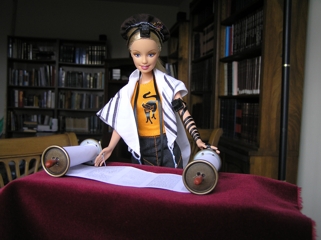 Jen Taylor Friedman's "Tefillin Barbie" broke out of the blogosphere to appear in Jewish Week this past week.
 If you're bummed that yours is on back-order, or troubled by her wardrobe choices, check out the Gali Girls, "Jewish dolls for Jewish girls," three of which are paired with a supporting curriculum.
"The Gali Girls Jewish History Series is a fun and informative way to teach students about the cultures, traditions, and beliefs that the Jewish people have held in their respective countries and communities across the globe and across the ages.
"We offer a FREE SAMPLE CURRICULUM with your purchase of any Gali Girls Jewish History Series book. Gali Girl dolls are also available to add depth and character to each story, and they also make a fun addition to your classroom's Shabbat celebration!"
 Either way, I think both would make a great companion for those mini-Torahs that you get on Simchat Torah every year.
To tie this all together, here is a list of ideas for playing with your mini-Torah, originally created for a family education program at Central Synagogue in NYC.
Older readers, on the other hand might, be best served by the Sigmund Freud hand puppet, which comes, of course, with a couch.
Monday, December 04, 2006
Simon Maccabee: A Chanukah Story
 My friends,
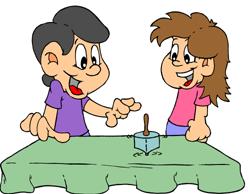
As Chanukah approaches, I'd like to share with you an original story that I wrote two years ago while Director of Education at Central Synagogue. I told this story at Friday night services as a lead in to the students in the 4th and 5th grades singing Debbie Friedman's "Not By Might." It is the story of Simon Maccabee, a lesser-known Maccabee sibling. Here is an excerpt:
I think most of us here know about Judah Maccabee . . . but not so many people have heard about his brother, Simon Maccabee. We don’t know a whole lot about him, but I think I remember hearing somewhere that Simon was a 4th or 5th grade teacher.The entire text is after the jump. Please feel free to pass it along and to retell it in your own words.
Simon wasn’t a great fighter, but he loved to cook. Each morning he would fry up some mighty tasty latkes. When his brothers would come home in the evening, they always had new people with them who had decided to join in the fight against the Syrians
. . . Soon, Simon was getting up earlier and earlier to peel the potatoes and fry up the onions, and long lines of soldiers would wait for the mighty tasty latkes. Simon started to arrive later for work and his students would all wait impatiently for him to begin his lessons.
Happy Chanukah!
Thursday, November 16, 2006
Rethinking the Jewish Cultural Renaissance
The November issue of Sh'ma, on Jewish Literary Culture, includes a piece Stephen Hazan Arnoff and I co-authored. Entitled "Producers and Consumer: Rethinking the Jewish Cultural Renaissance," we suggest that
If the first step in the current expansion of the Jewish cultural landscape has been establishing modes for producing and delivering the work of culture makers to engaged consumers, the next step is expanding the nature of Jewish cultural production so that a much fuller range of the community is empowered to build a richer and more vibrant Jewish world.
In the same way that many educational programs are increasingly moving away from the model of frontal education (that places the learner in a passive role and assumes that he or she will benefit from the expertise of teachers) in favor of an active-learning approach (that encourages exploration, experimentation, and problem-solving), we believe cultural programs should adapt the approach of workshops, think tanks, and chevrutas – creating environments in which every participant contributes as both a producer and a consumer of learning and culture.
As Sh'ma does not have a direct method for responding to the articles they post, Stephen and I would be delighted to read any feedback posted here.
Wednesday, September 13, 2006
The Perfect Chanukah Gift for the On-The-Go Executive
 Boing Boing reports:
"The Hannukit is a tiny, high-speed menorah made out of a piece of aluminum that you load with up to nine wooden matchsticks and set alight -- for people who like their holiday prayers fast."
Subscribe to:
Posts (Atom)