Showing posts with label assessment. Show all posts

Monday, October 03, 2011

Jewish Education Is About Living Jewish Values

I wrote the cover story for the Temple Emanu-El Bulletin, Vol. 84, No. 2, October 2011. Here is the text of the article:

In the fall of 2009, Congregation Emanu-El of the City of New York was named one of 24 “innovating congregations” in the New York area because of our dedication to educational transformation. We became a founding member of LOMED (Hebrew for “learning”), a coalition of diverse institutions from New York City, Long Island and Westchester, all committed to developing educational programs that are relevant, engaging and inspirational.

During the past academic year, LOMED provided the resources for us to create a four-minute video about our seventh grade Mitzvah Corps. (View it at www.youtube.com/emanuelnyc.) LOMED also awarded us a grant supporting professional development for our faculty and experimentation with new approaches to learning. We’ve put this funding to good use: After its pilot year, our eighth grade Lirdof Tzedek (“Seeking Justice”) program was identified as a “highly effective model” recommended for replication by other synagogues.

Most important, our work with LOMED has provided a framework to think deeply about the ultimate aims of our school. What is it we hope our children and their families will gain from the Religious School experience? How will it influence our community, both now and in the future? Through LOMED, we defined the purpose of Jewish education at Emanu-El: To support our families in living Jewish values.

Living Jewish values means much more than remembering stories from the Bible or being able to say a prayer in Hebrew. There are far too many examples of people who are knowledgeable and perhaps even religiously observant but who somehow fail to live ethically. For our students, studying a Bible story involves investigating the dilemmas faced by our ancestors and exploring their actions, the virtuous and the shameful, the praiseworthy and the irresponsible. We ask how the decisions they made might serve as examples in our striving to be wise, just and compassionate individuals.

Many ways exist for educators to talk about what we do, and as in any profession, much of it is insider jargon. LOMED provides a language with which we can articulate the goals of the school curriculum clearly and simply. Using the diagram that accompanies this article as a guide, our teachers collaborate to shape meaningful and vital learning experiences.

This diagram is a clever mnemonic device that highlights four dimensions of effective instruction. First, every lesson must engage and inspire the mind of the learner (the “head”). Second, the “hand” is a reminder that every learning experience must both incorporate and lead to action—perhaps a change in behavior or the development of a new skill. Third, we must consider the “hearts” of our learners, for in everything we teach we must ask, “Why should we care?” And finally, the “feet” remind us that effective Jewish education leads us to take a stand on our beliefs as a part of a community.

This “whole person” approach ensures that our Religious School program is responsive to the genuine questions of our learners, that the learning is applicable to daily life, and that our school community is one in which our children will grow into responsible and capable Jewish adults. Each classroom is a laboratory for Jewish living in which the teachers model the thoughtfulness and mutual respect that we seek to promote in our students. The care and concern our teachers have for each child enables our students to support one another and to challenge themselves to grow as individuals, as family members and as part of an ethical Jewish community.

We are fortunate to be the inheritors of ancient wisdom that guides us in living principled lives in complicated times. At Emanu-El, our students become reflective about their actions, passionate about their beliefs and kindhearted toward one another. As we strive to become the best people we can be, proud of our heritage while accepting no dogma blindly, we are prepared to join together with those of all faiths and backgrounds to build a just and virtuous society.

Thursday, March 04, 2010

Good Teachers Make a Difference. No, Really?

The NY Times finally tells us what we've all known all along - and does it really, really well. I can even (almost) forgive the writer, Elizabeth Green, for ending a sentence with a preposition:
"When researchers ran the numbers in dozens of different studies, every factor under a school’s control produced just a tiny impact, except for one: which teacher the student had been assigned to."
[The photo to the right is copyright Benjamin Norman for The New York Times.] The article begins by noting that paying higher salaries does help to attract and retain the best and most qualified teachers.  However, it also notes that we need to simultaneously be focused on improving pedagogy and content knowledge through professional development,  because of the vast number of teachers that the education system requires to operate (and especially at a time when the baby-boomer teachers are retiring).

The main focus of the article is Doug Lemov, author of an as-yet-unpublished, 375-page long taxonomy of 49 essential teaching techniques (apparently, he distributes it at training seminars, and it will be available from this spring).  Much of the piece describes effective classroom management techniques that the Times illustrates with videos narrated by Lemov. I suspect that every one of our Religious School teachers would benefit from watching these brief videos - and especially the Hebrew teachers.

The article is on-line as of this morning, and already is getting much buzz around the blogosphere (a term I use derisively, btw.  Nothing better than reading a piece in which the author writes "I haven't finished reading this article yet, but I had to post...").

You'll want to read the whole article so that you can read in context little gems like these:
"All Lemov’s techniques depend on his close reading of the students’ point of view, which he is constantly imagining. In Boston, he declared himself on a personal quest to eliminate the saying of “shh” in classrooms, citing what he called “the fundamental ambiguity of ‘shh.’ Are you asking the kids not to talk, or are you asking kids to talk more quietly?” A teacher’s control, he said repeatedly, should be “an exercise in purpose, not in power.”"
"...One [student] is playing with a pair of headphones; another is slowly paging through a giant three-ring binder. Zimmerli stands at the front of the class in a neat tie. “O.K., guys, before I get started today, here’s what I need from you,” he says. “I need that piece of paper turned over and a pencil out.” Almost no one is following his directions, but he is undeterred. “So if there’s anything else on your desk right now, please put that inside your desk.” He mimics what he wants the students to do with a neat underhand pitch. A few students in the front put papers away. “Just like you’re doing, thank you very much,” Zimmerli says, pointing to one of them. Another desk emerges neat; Zimmerli targets it. “Thank you, sir.” “I appreciate it,” he says, pointing to another. By the time he points to one last student — “Nice . . . nice” — the headphones are gone, the binder has clicked shut and everyone is paying attention.

"Lemov [explains] “Imagine if his first direction had been, ‘Please get your things out for class,’ ” he said. Zimmerli got the students to pay attention not because of some inborn charisma, Lemov explained, but simply by being direct and specific. Children often fail to follow directions because they really don’t know what they are supposed to do."
The article also notes that "content can’t be completely divorced from mechanics" and that different types of knowledge - mathematics, reading, science - require not only general skills but also ones unique to the subject. The implications for Jewish education are clear: There are skill sets that make for effective teaching of, say, Hebrew, that aren't necessarily the same as teaching about holidays or transferable if you can effectively teach French. Teachers need to be able to deeply understand the material and then be able to effectively share that knowledge with a room full of students who have diverse ways of thinking and learning.
"“If I’m asking my students a question, and I call on somebody, and they get it wrong, I need to work on how to address that,” [fifth-grade math teacher Katie] Bellucci explained in February. “It’s easy to be like, ‘No,’ and move on to the next person. But the hard part is to be like: ‘O.K., well, that’s your thought. Does anybody disagree? . . . I have to work on going from the student who gets it wrong to students who get it right, then back to the student who gets it wrong and ask a follow-up question to make sure they understand why they got it wrong and understood why the right answer is right.”"
Interestingly, although Lemov's taxonomy, or a similar mathematics-content-driven approach developed by Deborah Loewenberg Ball at the University of Michigan, can be used as a metric to observe what makes for effective education, there isn't clear evidence that these skill sets can actually be taught.
"Jonah Rockoff, an economist at Columbia University ... favors policies like rewarding teachers whose students perform well and removing those who don’t but looks skeptically upon teacher training. He has an understandable reason: While study after study shows that teachers who once boosted student test scores are very likely to do so in the future, no research he can think of has shown a teacher-training program to boost student achievement. So why invest in training when, as he told me recently, “you could be throwing your money away”?"
Which brings us back to the original point: Now that we may be able to assess what skills are evidence of effective teaching, we need to offer salaries that will attract and keep the most qualified people in the classroom.

I'm encouraging all of my school faculty to read the article, and especially to watch the videos that the Times has posted. This is some good stuff.

Thursday, February 18, 2010

The more things stay the same . . .

I thought this was as good a time as any to share with you a few choice quotes from David Resnick's terrific article, The Current State of Research in Jewish Education, which appears in Studies in Jewish Education, Volume III:
"... There is no deep-seated desire on the part of educational consumers to improve educational effectiveness. This is not to say that Jewish parents do not care about their children's Jewishness. Indeed, Jewish education for many American Jews serves as the key expression of their Jewishness, rather than as an instrument of educational mastery. 

"The nature of the dissatisfaction expressed by parents about school programs is usually more about the appeal of the program to the child, than about its failure to achieve particular subject matter goals.

"... Attending school, rather than achievement in school, is the primary, even if implicit, goal of Jewish education  —  at least in its supplementary form... The desire for identification rather than instructional effectiveness characterizes the culture of the Jewish school.

"Furthermore, community preoccupation with a host of other quasi-research issues — censuses of Jewish students; calculations of percentage of eligible students receiving a Jewish education; drop-out rates; retention rates; successful outreach programs — indicates concern with getting and keeping students in the educational system as the primary goal. Enhancing the instructional effectiveness of that system is not a priority.

"... Since failure to achieve even minimal learning levels has next to no social consequences (aside from mastery of Bar Mitzvah skills), there is little need for research related to the improvement of educational attainment. In this regard, it is worth bearing in mind that much of the recent push for excellence in general education has been at the behest of private industry and higher education, both of which bear the brunt of ineffective schools. No comparable institutional demand exists in American Jewish life."
This article was published in 1988.

Tuesday, September 08, 2009

Neuroscience research shows that Big Bird was right: Praise effort, not ability

I am just lifting this wholesale from a review of the book "How we Decide" by Jonah Lehrer, appearing on Boing-Boing:

"...mistakes are critical to good decision-making, as they are our best tutors. Lehrer describes a famous study from Stanford psych research Carol Dweck, who administered easy tests to 10-year-olds, who did well on it. The control group was praised for 'being smart.' The experimental group was praised for 'trying hard.'

With only this difference, the two groups were then administered progressively harder tests. Dweck discovered that the 'smart' kids did worse: they believed their initial good result was due to some innate virtue beyond their ken or control, and feared that a failure would show that they lacked this intangible. But the 'hard-trying' group had been rewarded for taking intellectual risks, and so they continued.

Afterwards, the 'smart' kids rated the hardest tests as their least favorite; the 'tryers' rated it as their most favorite."

Read the full review, by Cory Doctorow, for more about dopamine, meta-cognition, introspection, and how having too many choices leads us to make poorer decisions.

Monday, May 28, 2007

Cory says, "Homework Sucks!"

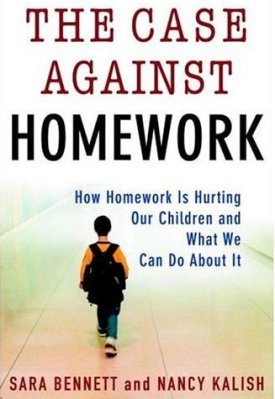
Today on Boing Boing: Cory Doctorow's review of The Case Against Homework by Sara Bennett and Nancy Kalish. He calls it "a fine and frightening explosion of the homework myth: that giving kids homework improves their educational outcome..."

"...all the credible research on homework suggests that for younger kids, homework has no connection with positive learning outcomes, and for older kids, the benefits of homework level off sharply after the first couple assignments...

"...Not that most teachers would know this -- homework theory and design isn't on the curriculum at most teachers' colleges, and most teachers surveyed report that they have never received any training on designing and assessing homework...

"...The stories go on and on, and just when you're ready to throw in the towel and send your kids into the woods to be raised by wolves, the authors supply several long chapters of strategies and sample dialogs for convincing your kids' teachers to ease off on homework, for changing the homework policies in your school district and for rallying other parents to their cause.

"They're not whistling Dixie, either: the authors have gone through this themselves, challenging and changing the homework policies in their kids' school districts. The last section of the book is an activist guide and a postmortem of the strategies they employed. One of the authors, Sara Bennett, is a celebrated civil rights lawyer; the other, Nancy Kalish, is a famous editor and writer of material for parents, especially mothers. One imagines that their school board didn't know what hit them" [full text of review].

More information can be found on StopHomework.com, co-author Sara Bennett's blog. She recommends taking action by signing the petition calling for the dismantling of the "No Child Left Behind" Act at The Educator Roundtable.

Tuesday, October 03, 2006

Kinky Friedman . . . Good for the Teachers!

Kinky Friedman, the Jewish cowboy/folk-singer/mystery-novel writer and independent candidate in the Texas gubernatorial race, was quoted in The Pine Log (Austin State University's newspaper) as advocating the legalization of gambling in Texas in order to raise teacher's salaries. Staff writer Jesse Williams writes:
He said teachers had the most important job but are paid $6,000 below the national average. Friedman said gambling would bring $8 billion for teachers. Texans must go out of state to gamble. "We invented Texas Hold'Em, and we can't play it," he said.
Besides teacher's pay, he also said that what teachers instruct students should change. He said that Texas is one of the richest states but has the poorest student grades. Friedman said students should be taught things other than what's on the TAKS test. "We've created a generation of kids who don't know if the Civil War was here or in Europe," Friedman said.

With the campaign slogan "why the hell not?," it is hard to imagine how any dissatisfied Texan voter could resist voting for the man who wrote "They ain't making Jews like Jesus anymore." But if you'd like to be convinced a little more, check out one of his cartoon campaign messages on myspace.

UPDATE (10/3): Thanks to BZ for alerting me that Kinky might not be an all-around ideal candidate -- I'm not so comfortable with certain remarks that he claims were made satirically about Katrina refugees, for example, and he has some disconcerting views about illegal immigration and school prayer.

Of course, one might find the idea of using gambling proceeds as a way to pay for teacher's salaries troubling in the first place.