Showing posts with label preschool. Show all posts

Friday, December 02, 2011

How to help your daughter's teachers re-think gender

There's so much good stuff going on right now to help Jewish boys and girls grow up with a sense of self-confidence -- and one that isn't predicated on gender stereotypes. But what do you do when your child's teacher didn't grow up attending Moving Traditions programs, hasn't been to a training on the "evaded curriculum" and doesn't even realize that Jewish chicks rock?

Julie Sissman writes:
"I wanted to share with you the email below that I wrote to my daughter's school administrators. Not in response to any incident or specific concern I had about the school, but rather in response to my ongoing fear/concern about raising strong, healthy girls with high self-esteem and confidence - and my concern about raising boys who see their full range of humanity open to them, rather than a narrow view of what 'masculine' means.

"I encourage you to use this email as a template to edit and send on to your own kids' school administrators and community group leaders (or forward to friends/siblings with kids). If we each take up this important issue, and each school does professional development around it, we could, together, have a big impact. (Obviously, if your child doesn't go to a Jewish school, then you wouldn't include the Jewish-related items. Similarly, if your kid is well past pre-school, you would put in different examples.)

"To give extra motivation - I sent this to our school, not knowing what response I would get. They took it up very seriously and appreciatively, spending 3.5 hours today on a professional development workshop for faculty and administrative leaders on the topic.

"If you're in NYC - I actually designed and facilitated the workshop! And I'd be happy to bring it to your school, also.

"Here's to building a world where both girls and boys see a broader range of possibilities!"

Here's Julie's letter:
Hi xxx,

I never fail to notice how often someone limits my daughter's choices - at the doctor's office, when they say "Do you want princess stickers?" At the arts shop, when they say "Do you want pink paint?" I recently saw a couple of articles that made me think more about how gender is "taught" (formally/consciously and unconsciously) to children, which prompted me to write this email. 

Our children spend so much time in school and their teachers and administrators have such a powerful influence on their individual thinking, as well as their group dynamic. Therefore, it's incredibly important that teachers and administrators have a gender lens as they look at what goes on in the classroom and as they interact with children. Here are a few examples:
  • Do the teachers react with as much excitement when girls build a tower with blocks ("Look at how tall/complex that tower is!!!!!!!!!") as when they dress up as Snow White ("You look so beautiful!!!!!!!!!")? 

  • Do they offer all children, both boys and girls, varied options for exploring the world (such as puzzles and blocks or art/crafts) and equivalent suggestions for play-acting ("Would you like to dress up as a firefighter today?") 

  • Similarly around holidays - Because there are so many more men in the stories and holidays, are teachers/administrators going out of their way to bring women's stories and women's voices in?  Is Esther viewed as a critical protagonist or as a confused and scared accomplice to Mordechai? Are figures like Deborah brought in to the curriculum?  Is Miriam highlighted as a critical player in the Pesach story as well as Moses? Are Ushpizot invited into the sukkah, in addition to the traditional group of Ushpizin? 

  • Are girls encouraged towards math and science as much as boys are?  

  • Are teachers aware - or do administrators who observe point out - any subtle differences in ways that teachers interact with boys and girls?  

  • What ongoing professional development and ongoing feedback is included/provided for faculty - especially those who may have grown up in communities where girls and boys were not given the same opportunities?
I'm hoping that school can be a place where my daughter's options are kept as open as possible - which is only possible if her teachers have an awareness of these types of things and how limiting they can be. Especially since many other children will be perpetuating gender stereotypes with their words and actions, I'm hoping that the teachers will help keep open the windows to opportunity.

These windows of opportunity are, of course, also important for the boys. There's a world and palette that our society tries to limit boys to, also.

These articles that I read not only comment on what teachers say and what they encourage, they also comment on what is included in classrooms. For example, perhaps the preschool classrooms do not need to have high heeled shoes for the kids to dress up in. As I've watched the girls having to walk gingerly around the classroom, I've wondered, "Is 3 years old really the age at which we want to impede our girls' movement in this way? We don't have shoe-dress-up for police officers or firefighters or chefs. Maybe dressing up the body but not the feet is good enough for a princess, also."

In case you're interested, I'm including the links to the articles that prompted me to write now. I'd be happy to hear your reactions. And I'd love to hear more about how the school - both in the preschools and beyond - thinks about these issues. One of the things my husband and I love most about the school is how thoughtful you all are, so I'm sure you already have a point of view! :)

Thanks for listening,

Julie

And here are the articles Julie recommends, that led her to write this letter in the first place:
1. How to Talk to Little Girls, by Lisa Bloom (Huffington Post). "This piece resonated a lot with me because I've been struck how waiting in the morning for school to start, almost every parent says to each girl as she arrives, 'Hi! I love your dress/hair/shoes/coat/etc.' I've been bothered, but couldn't quite articulate it to myself. This does a great job."

2. Taking a Stand Against the Princess Culture, by Susan Tomchin (Jewish Woman Magazine). "An interview with Peggy Orenstein, author of Cinderella Ate My Daughter. This made me think about how girls are dressing up, how Talia's already asking me to wear nail polish (because she sees other girls wearing it), etc. and helped paint a broader context for all of that."

3. The film Miss Representation. "This film focuses on media and advertising - I think it's a really important film."

Do you have suggestions of other resources and must-reads? Post them in the comments.

Tuesday, May 15, 2007

Sesame Street returns to Israeli and Palestinian television

Off the air (due to a lack of funding) since 1997, "Rehov Sumsum" returned to the Israeli children's cable television network "Hop!" this past Chanukah (2006). This week, Ma'an, an independent network of Palestinian television stations will begin broadcasting their version of the series. Ha'aretz reports:

"...Producers tailored the Middle Eastern casts and story lines to the fit the audiences. 'Rehov Sumsum,' the Israeli version of the show, for the first time includes a Muppet of Arab origin. Its Palestinian counterpart, 'Shara'a Simsim,' seeks to offer positive role models to boys in the West Bank and Gaza Strip." (April 30, 2007)

A little background:

"...After the shows ended in 1997, a joint Palestinian-Israeli production in the planning stages was shelved when the Palestinians launched the second intifada in 2000.

"Instead, a limited series called 'Sesame Stories' was produced in 2004 by independent Israeli, Palestinian and Jordanian production teams. The animations and live-action episodes were dubbed and aired on each other's series.

'The Muppets couldn't speak each other's languages, but they connected over falafel and hummus, and a common dislike of onions,' Knell said.

"The new Israeli and Palestinian shows are produced independently, placing an emphasis on educating children about their own societies. Like any "Sesame Street," they also teach basic skills like numbers and letters, good manners and keeping the environment clean.

"'Rechov Sumsum' teaches tolerance by portraying a street inhabited by Israelis of varying backgrounds who live together peacefully: Jews and Arabs, religious and secular, veterans and immigrants. The neighbors are real-life children and adult characters, including a Jewish man named Tzahi, an Arab woman named Ibtisam, a Russian woman named Irina and an Ethiopian student named Malkamo." (JTA, May 14, 2007)

Sesame Workshop, in a press release from last December, described the initiative as part of their commitment "to creating and providing positive media content for children in the Middle East." Along with the new Israeli and Palestinian versions, this includes productions in Egypt ('Alam Simsim', now entering its 10th year) and Jordan (Hikayat Simsim). The new Palestinian series:

"...will be accompanied by an educational outreach campaign, will feature a new set that now includes a Fix-It shop run by Salim, a new male character in his early 20’s. Beloved Palestinian Muppet characters Haneen, a 5-year-old learning how to count and read, and Kareem, a 7-year-old rooster, who is organized, tidy, timely, and traditional, return to Shara’a Simsim. The new season responds directly to the needs of Palestinian children by focusing on boys’ empowerment and introducing the character of Salim, who will serve as a positive role model for young children."

All this is great news for Israelis (and the rest of us) who until now have had to turn to YouTube to hear "Barvazoni" ("Rubber Duckie" sung in Hebrew).

Monday, February 26, 2007

Playing with Dolls

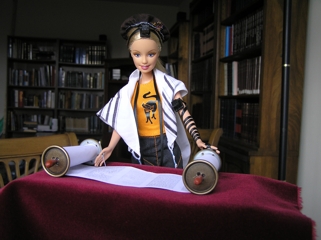
Jen Taylor Friedman's "Tefillin Barbie" broke out of the blogosphere to appear in Jewish Week this past week.

If you're bummed that yours is on back-order, or troubled by her wardrobe choices, check out the Gali Girls, "Jewish dolls for Jewish girls," three of which are paired with a supporting curriculum.
"The Gali Girls Jewish History Series is a fun and informative way to teach students about the cultures, traditions, and beliefs that the Jewish people have held in their respective countries and communities across the globe and across the ages.

"We offer a FREE SAMPLE CURRICULUM with your purchase of any Gali Girls Jewish History Series book. Gali Girl dolls are also available to add depth and character to each story, and they also make a fun addition to your classroom's Shabbat celebration!"

Either way, I think both would make a great companion for those mini-Torahs that you get on Simchat Torah every year.

To tie this all together, here is a list of ideas for playing with your mini-Torah, originally created for a family education program at Central Synagogue in NYC.

Older readers, on the other hand might, be best served by the Sigmund Freud hand puppet, which comes, of course, with a couch.

Wednesday, December 13, 2006

...and in the news this week...

Brooklyn has more upmarket preschoolers than it can handle, reports New York Magazine in "The Preschooler Glut:"

The brownstone-Brooklyn baby boom is causing a sort of educational crisis in the once easygoing borough, leading parents to wonder: When did this turn into Manhattan? A flood of would-be students has forced the area’s premier preschools (where tuition is five figures) to close their application season as much as three months early.

The Conservative movement's Solomon Schechter day schools are considering changing their bylaws to admit the children of non-Jewish mothers, reports this JTA article. More detailed analysis is offered by the Baltimore Jewish Times. Sue Fishkoff asks in her a follow-up article:

If Solomon Schechter day schools begin to admit children of non-Jewish mothers, will that draw students away from Reform or community day schools? [...] Zena Sulkes, day school specialist for the Union of Reform Judaism, said she does not anticipate an exodus from the 19 schools affiliated with the Progressive Association of Reform Day Schools. Since Schechter schools already quietly admit non-halachically Jewish children, those families looking for a Schechter education are already going there, she suggested. Others won’t be tempted.