Dear School Families,During Religious School on Sunday and Monday, we did not explicitly raise the tragic events at Tree of Life Synagogue in Pittsburgh with our students. We know that every child is different, and each family must choose to handle the situation in its own way. Yet, we also know that many of our children have questions and fears that we, as their parents, want to address – not to mention our own, adult concerns.I want to share with you the guidance I gave our faculty, which holds for parents as well:
- If the children bring up the topic, don’t shut it down. Listen attentively to what they have to say -- their concerns and their questions, their thoughts and feelings -- and let that drive the conversation.
- Try to answer questions factually without adding unnecessary details. Don’t assume that your questions and concerns are theirs.
- Reassure the children that Temple Emanu-El is a safe place; we are a sanctuary for all people seeking comfort and support. Here at Emanu-El, there are many adults who are looking out for them and who know exactly what to do to prevent emergencies of all types from happening. A good example is that when there is a fire drill, we all are trained to respond quickly and safely. There are other things that the kids don’t know about that we, the adults, are doing to keep them safe.
- Let them know that an important part of what it means to be Jewish is that when we hear about tragedy, we want to respond. That is why Emanu-El is participating in city-wide vigils (both to express our emotions and to demonstrate our solidarity) and why our Philanthropic Committee and Student Council are already talking about what we can do to help the people of the Tree of Life Community.
- Remind them that there are always many more people trying to be good than to do harm, of all religions, backgrounds, and nationalities. Unfortunately, it is so much easier to be destructive than to build, and bad news always gets the headlines – but remember, although there are some dangerous people in the world, nearly everyone you meet is a kind, generous, loving person like yourself.
Showing posts with label policy. Show all posts
Showing posts with label policy. Show all posts
Wednesday, October 24, 2018
Talking with our children about tragic events
This is what I shared with the Religious School community at Temple Emanu-El after the events at Tree of Life Synagogue:


Thursday, March 01, 2018
The Golden Age of Religious School Education
I wrote this article for the March-April 2018 edition of the Temple Emanu-El Bulletin.
The challenges of Jewish education are largely the same as they were more than a century ago, when the first generations of American Jews began attending supplementary schools. Forced by these challenges to be inventive and resourceful, the best educators integrated innovative approaches and cutting-edge practices. And yet, because we are in an era of unprecedented collaboration, I believe we are now in a “Golden Age” for religious schools.
Monday, September 18, 2017
Where have all the Teachers Gone? A Collaborative Community Response
This article about the course I will be teaching this semester, authored by Dr. Evie Levy Rotstein, appeared in eJewishPhilanthropy on September 14, 2017:
Each year the challenge seems to grow. Jewish educators are frantically searching for qualified teachers to fill open positions in their religious schools. Research for many years has indicated that there is a shortage of well-trained teachers in Jewish settings, exacerbated by the challenge of retaining strong teachers for these part-time positions. (Westheimer, 2007). This past summer, though, the problem was particularly striking: I received more requests than ever for graduate students to fill multiple empty positions in the New York metropolitan area. Is this problem intractable, or can something be done?
Last winter, a group of seasoned NYC educators that form a peer network group hosted by the Jewish Education Project in Manhattan began to explore this very issue. They discussed how they might collaborate to offer high level professional learning to encourage current religious school teachers to become teacher leaders. One of the educators, Saul Kaiserman, teaches our “Laboratory in Teaching in Learning” course to rabbinic, cantorial and Masters in Religious Education students at HUC-JIR New York School of Education. What would happen if these educators could offer their faculty members such a course for graduate credit at a highly subsidized tuition fee? What if the congregations themselves paid for the course and then offered the teachers a salary bonus upon the completion of the course? Might avocational teachers begin to consider a career in Jewish education? There was significant back and forth as the group hammered out what they would want in such a course, whether their teachers would realistically attend such a course, how many transferable credits it would be, and ultimately if the finances would be feasible.
And behold a strategy for change was born. HUC-JIR made the bold decision to offer students enrollment at an incredibly subsidized rate, similar in cost to the introductory course for the Executive Master’s Program. The professor offered to teach the course gratis, Congregation Emanu-El of the City of New York agreed to host the course, and all of the congregations were willing to provide the funding for the tuition. At the time of writing, teachers representing congregations across NYC have applied for a spot in this course
This is a story of community collaboration and the desire to address the challenges of the teacher shortage and retention. We as leaders in the field of Jewish education must continue to find ways to recognize and validate the fact that our teachers need to continue their own growth and learning to keep them from leaving the field. We know from the data, that teachers who do not participate in ongoing professional development are less effective in the classroom and less likely to meet the emerging needs of students, administrators, and the field of Jewish education. Our hope is that this course may be the catalyst for teachers to seek a graduate degree and ultimately a full time career in Jewish education. We also need to think about the future of Jewish education leadership.
If you are interested in learning more about the course please follow this link or contact Dr. Evie Rotstein at erotstein@huc.edu.
Thursday, August 21, 2014
Why do we bless our bread? (Part II)
Continuing to mine my master's thesis on Birkat Ha-Mazon, the grace after meals, as we build up to the shmita year, this week I share with you the section on using the prayer as an opportunity to focus on proper nutrition. I won't overstate the analogy, but I believe that just as saying this prayer can be a time for personal and communal reflection on issues relating to food, diet and nutrition, so too can we look at the coming year as a chance to rethink and renew our approaches to these topics. The thesis in its entirety can be found online at the Lookstein Center for Jewish Education. The full text of this section is after the jump.
The World Health Organization defines "Health" as balance between physical, mental and social being. Birkat Ha-Mazon reminds us of the need to pay attention to, and strike a balance between, each one of these aspects of our health. Birkat Ha-Mazon is a social activity, as it is often said as the conclusion of a communal meal. Focusing on the text can lead to heightened cognitive awareness of, and encounter with, challenging issues affecting Jews and people in general. Here, I wish to look at the role that Birkat Ha-Mazon can play as a focal point in thinking about the physical impact of food on our bodies, or in other words, for nutrition education.
According to Genesis 1:26, humans are created “b’tzelem Elohim,” in the image of God. Although the interpretations of this are manifold, one generally accepted implication is that any form of self-harm violates Jewish law as it is a desecration of the Divine image. The extent to which this principle is applied varies: Some communities forbid body-piercing based on this idea, while others will not smoke cigarettes. Arguably, a concern for proper diet and exercise should be considered a Jewish obligation.
Birkat Ha-Mazon is a mandatory pause at the conclusion of a meal. We can use this time to make a connection between the food we have eaten and the nourishment it has provided us. This is also an opportunity for us to reflect upon the choices we have made with the foods we have eaten. One might ask oneself questions along the lines of: Did I waste food? Did I overeat? Was the food grown (or raised) in a manner that fits with my ethics? How did this food get from its point of origin to me? How did the choices I made affect other people’s lives?
Monday, November 04, 2013
Vision-Driven Institutions: Solomon Schechter School of Manhattan
In 2007, I wrote on this blog about the Heschel Center for Environmental Learning and Leadership in Israel. At the time, I expressed my skepticism about my ability to turn this into a regular feature, but here I am, just six short years later, with a description of another innovative institution, the Solomon Schechter School of Manhattan. I wrote this piece as part of my coursework for the executive doctoral program at the Davidson School of Education. This is not a comprehensive discussion of the institution, but a description of just one element of the program, and the institutional leader who created it.
Dr. Steven Lorch is the founding headmaster of the Solomon Schechter School of Manhattan, a K-8 Jewish Day School on the Upper West Side of Manhattan that is currently in its 18th year. I taught at Schechter Manhattan for three years. I loved its team-teaching approach (every class is led by two teachers, both fluent in Hebrew, who share responsibility for all areas of the curriculum), its constructivist philosophy, and its focus on menschlichkeit [kindness and empathy] as a core component of the institution. Yet, no aspect of my work there has influenced me more thoroughly than the experience of leading daily worship and teaching its tefilah [prayer] curriculum. At both Central Synagogue and Congregation Emanu-El of the City of New York, the two institutions I have served since leaving Schechter Manhattan, I have attempted to adapt the Schechter prayer curriculum to suit the needs of a Reform Jewish supplementary school setting. This sketch focuses solely on this aspect of Dr. Lorch’s work: His role as the creator of the Schechter Manhattan tefilah curriculum.
Friday, October 21, 2011
Should Religious School be Cancelled on Halloween?

This poses a unique challenge for religious schools. Unlike Thanksgiving or New Year's Day, Halloween is not a national holiday, and secular schools do not close. Yet, practically speaking, for many children in the United States, the afternoon of the 31st is meant for trick-or-treating - exactly the time-slot when religious school is in session. And when I say "many," I think back to the last time that Halloween fell on a day when our school was in session. Out of 75 students, exactly six showed up. One kid brought his mom, and I overheard him telling her, "You see, I TOLD you I would be the only fifth grader here!"
So this leaves religious school principals in a complicated position. On the one hand, it is hard to rationalize closing school for a non-Jewish holiday (I'll say here, parenthetically, that although some Jewish schools and teshuvot take a strong stance against Jews participating in any non-Jewish celebrations, I find unconvincing the arguments that Halloween is a "Christian" or "pagan" celebration. True, it has pagan roots, but so do many Jewish holidays and rituals. There are indeed Celtic neopagans celebrating Samhain on October 31, but that's not really the issue here. And, we aren't talking about cancelling school on November 1, "All Saint's Day," but on "All Hallow's Eve," the night before; Halloween can be confusing and problematic for Christians too).
On the other hand, how do we ignore the reality that many of the kids will skip school, and that this will impact the experience of the ones who do attend? Do we take a public stance on whether or not it is okay for kids who do attend - and faculty - to come in costume?
So what to do? I know of several schools that close for the day and instead run an in-service for their faculty. This is a sensible response, and consistent with how some schools handle other holidays, such as Veteran's Day or Martin Luther King, Jr. Day.
Other schools allow for, or even informally encourage, early dismissal - a sort of compromise approach.
 Still others offer special programming on the day, meant to entice students to view school as both a worthwhile alternative to trick-or-treating and to feel rewarded for their attendance. One school I know offered a program on demons, ghosts and witchcraft in Judaism; another ran "Purim in October."
We are in the fortunate position at Congregation Emanu-El of running a one-day a week school that offers classes on Sundays as well as weekday afternoons. We have a general policy of encouraging students who are unable to attend on their usual day of school to attend on the other day. In fact, we've had students who regularly alternate between Sunday and weekday attendance, including children of divorced parents who have alternate custody over weekends and kids who change their day of school with the change in sports seasons. This year, we will suggest that parents whose children might miss school on the 31st should send their children on the 30th instead. I'll let you know in the comments section how this goes.
This is, of course, just the first year in a new cycle of dealing with the "October Dilemma." In 2012 and 2013, when Halloween falls on a Wednesday and Thursday, it will conflict with the schedules of many religious schools. Then, in 2014, we'll turn this problem over to the clergy; they'll have to figure out how to handle attendance at All Hallow's Eve of Shabbat.
Monday, October 03, 2011
Jewish Education Is About Living Jewish Values
I wrote the cover story for the Temple Emanu-El Bulletin, Vol. 84, No. 2, October 2011. Here is the text of the article:
In the fall of 2009, Congregation Emanu-El of the City of New York was named one of 24 “innovating congregations” in the New York area because of our dedication to educational transformation. We became a founding member of LOMED (Hebrew for “learning”), a coalition of diverse institutions from New York City, Long Island and Westchester, all committed to developing educational programs that are relevant, engaging and inspirational.
During the past academic year, LOMED provided the resources for us to create a four-minute video about our seventh grade Mitzvah Corps. (View it at www.youtube.com/emanuelnyc.) LOMED also awarded us a grant supporting professional development for our faculty and experimentation with new approaches to learning. We’ve put this funding to good use: After its pilot year, our eighth grade Lirdof Tzedek (“Seeking Justice”) program was identified as a “highly effective model” recommended for replication by other synagogues.
Most important, our work with LOMED has provided a framework to think deeply about the ultimate aims of our school. What is it we hope our children and their families will gain from the Religious School experience? How will it influence our community, both now and in the future? Through LOMED, we defined the purpose of Jewish education at Emanu-El: To support our families in living Jewish values.
Living Jewish values means much more than remembering stories from the Bible or being able to say a prayer in Hebrew. There are far too many examples of people who are knowledgeable and perhaps even religiously observant but who somehow fail to live ethically. For our students, studying a Bible story involves investigating the dilemmas faced by our ancestors and exploring their actions, the virtuous and the shameful, the praiseworthy and the irresponsible. We ask how the decisions they made might serve as examples in our striving to be wise, just and compassionate individuals.
Many ways exist for educators to talk about what we do, and as in any profession, much of it is insider jargon. LOMED provides a language with which we can articulate the goals of the school curriculum clearly and simply. Using the diagram that accompanies this article as a guide, our teachers collaborate to shape meaningful and vital learning experiences.
This diagram is a clever mnemonic device that highlights four dimensions of effective instruction. First, every lesson must engage and inspire the mind of the learner (the “head”). Second, the “hand” is a reminder that every learning experience must both incorporate and lead to action—perhaps a change in behavior or the development of a new skill. Third, we must consider the “hearts” of our learners, for in everything we teach we must ask, “Why should we care?” And finally, the “feet” remind us that effective Jewish education leads us to take a stand on our beliefs as a part of a community.
This “whole person” approach ensures that our Religious School program is responsive to the genuine questions of our learners, that the learning is applicable to daily life, and that our school community is one in which our children will grow into responsible and capable Jewish adults. Each classroom is a laboratory for Jewish living in which the teachers model the thoughtfulness and mutual respect that we seek to promote in our students. The care and concern our teachers have for each child enables our students to support one another and to challenge themselves to grow as individuals, as family members and as part of an ethical Jewish community.
We are fortunate to be the inheritors of ancient wisdom that guides us in living principled lives in complicated times. At Emanu-El, our students become reflective about their actions, passionate about their beliefs and kindhearted toward one another. As we strive to become the best people we can be, proud of our heritage while accepting no dogma blindly, we are prepared to join together with those of all faiths and backgrounds to build a just and virtuous society.

Thursday, March 04, 2010
Good Teachers Make a Difference. No, Really?
The NY Times finally tells us what we've all known all along - and does it really, really well. I can even (almost) forgive the writer, Elizabeth Green, for ending a sentence with a preposition:
 [The photo to the right is copyright Benjamin Norman for The New York Times.] The article begins by noting that paying higher salaries does help to attract and retain the best and most qualified teachers. However, it also notes that we need to simultaneously be focused on improving pedagogy and content knowledge through professional development, because of the vast number of teachers that the education system requires to operate (and especially at a time when the baby-boomer teachers are retiring).
The main focus of the article is Doug Lemov, author of an as-yet-unpublished, 375-page long taxonomy of 49 essential teaching techniques (apparently, he distributes it at training seminars, and it will be available from this spring). Much of the piece describes effective classroom management techniques that the Times illustrates with videos narrated by Lemov. I suspect that every one of our Religious School teachers would benefit from watching these brief videos - and especially the Hebrew teachers.
The article is on-line as of this morning, and already is getting much buzz around the blogosphere (a term I use derisively, btw. Nothing better than reading a piece in which the author writes "I haven't finished reading this article yet, but I had to post...").
You'll want to read the whole article so that you can read in context little gems like these:
I'm encouraging all of my school faculty to read the article, and especially to watch the videos that the Times has posted. This is some good stuff.
"When researchers ran the numbers in dozens of different studies, every factor under a school’s control produced just a tiny impact, except for one: which teacher the student had been assigned to."
The main focus of the article is Doug Lemov, author of an as-yet-unpublished, 375-page long taxonomy of 49 essential teaching techniques (apparently, he distributes it at training seminars, and it will be available from this spring). Much of the piece describes effective classroom management techniques that the Times illustrates with videos narrated by Lemov. I suspect that every one of our Religious School teachers would benefit from watching these brief videos - and especially the Hebrew teachers.
The article is on-line as of this morning, and already is getting much buzz around the blogosphere (a term I use derisively, btw. Nothing better than reading a piece in which the author writes "I haven't finished reading this article yet, but I had to post...").
You'll want to read the whole article so that you can read in context little gems like these:
"All Lemov’s techniques depend on his close reading of the students’ point of view, which he is constantly imagining. In Boston, he declared himself on a personal quest to eliminate the saying of “shh” in classrooms, citing what he called “the fundamental ambiguity of ‘shh.’ Are you asking the kids not to talk, or are you asking kids to talk more quietly?” A teacher’s control, he said repeatedly, should be “an exercise in purpose, not in power.”"
"...One [student] is playing with a pair of headphones; another is slowly paging through a giant three-ring binder. Zimmerli stands at the front of the class in a neat tie. “O.K., guys, before I get started today, here’s what I need from you,” he says. “I need that piece of paper turned over and a pencil out.” Almost no one is following his directions, but he is undeterred. “So if there’s anything else on your desk right now, please put that inside your desk.” He mimics what he wants the students to do with a neat underhand pitch. A few students in the front put papers away. “Just like you’re doing, thank you very much,” Zimmerli says, pointing to one of them. Another desk emerges neat; Zimmerli targets it. “Thank you, sir.” “I appreciate it,” he says, pointing to another. By the time he points to one last student — “Nice . . . nice” — the headphones are gone, the binder has clicked shut and everyone is paying attention.The article also notes that "content can’t be completely divorced from mechanics" and that different types of knowledge - mathematics, reading, science - require not only general skills but also ones unique to the subject. The implications for Jewish education are clear: There are skill sets that make for effective teaching of, say, Hebrew, that aren't necessarily the same as teaching about holidays or transferable if you can effectively teach French. Teachers need to be able to deeply understand the material and then be able to effectively share that knowledge with a room full of students who have diverse ways of thinking and learning.
"Lemov [explains] “Imagine if his first direction had been, ‘Please get your things out for class,’ ” he said. Zimmerli got the students to pay attention not because of some inborn charisma, Lemov explained, but simply by being direct and specific. Children often fail to follow directions because they really don’t know what they are supposed to do."
"“If I’m asking my students a question, and I call on somebody, and they get it wrong, I need to work on how to address that,” [fifth-grade math teacher Katie] Bellucci explained in February. “It’s easy to be like, ‘No,’ and move on to the next person. But the hard part is to be like: ‘O.K., well, that’s your thought. Does anybody disagree? . . . I have to work on going from the student who gets it wrong to students who get it right, then back to the student who gets it wrong and ask a follow-up question to make sure they understand why they got it wrong and understood why the right answer is right.”"Interestingly, although Lemov's taxonomy, or a similar mathematics-content-driven approach developed by Deborah Loewenberg Ball at the University of Michigan, can be used as a metric to observe what makes for effective education, there isn't clear evidence that these skill sets can actually be taught.
"Jonah Rockoff, an economist at Columbia University ... favors policies like rewarding teachers whose students perform well and removing those who don’t but looks skeptically upon teacher training. He has an understandable reason: While study after study shows that teachers who once boosted student test scores are very likely to do so in the future, no research he can think of has shown a teacher-training program to boost student achievement. So why invest in training when, as he told me recently, “you could be throwing your money away”?"Which brings us back to the original point: Now that we may be able to assess what skills are evidence of effective teaching, we need to offer salaries that will attract and keep the most qualified people in the classroom.
I'm encouraging all of my school faculty to read the article, and especially to watch the videos that the Times has posted. This is some good stuff.
Thursday, February 18, 2010
The more things stay the same . . .
I thought this was as good a time as any to share with you a few choice quotes from David Resnick's terrific article, The Current State of Research in Jewish Education, which appears in Studies in Jewish Education, Volume III:
"... There is no deep-seated desire on the part of educational consumers to improve educational effectiveness. This is not to say that Jewish parents do not care about their children's Jewishness. Indeed, Jewish education for many American Jews serves as the key expression of their Jewishness, rather than as an instrument of educational mastery.This article was published in 1988.
"The nature of the dissatisfaction expressed by parents about school programs is usually more about the appeal of the program to the child, than about its failure to achieve particular subject matter goals.
"... Attending school, rather than achievement in school, is the primary, even if implicit, goal of Jewish education — at least in its supplementary form... The desire for identification rather than instructional effectiveness characterizes the culture of the Jewish school.
"Furthermore, community preoccupation with a host of other quasi-research issues — censuses of Jewish students; calculations of percentage of eligible students receiving a Jewish education; drop-out rates; retention rates; successful outreach programs — indicates concern with getting and keeping students in the educational system as the primary goal. Enhancing the instructional effectiveness of that system is not a priority.
"... Since failure to achieve even minimal learning levels has next to no social consequences (aside from mastery of Bar Mitzvah skills), there is little need for research related to the improvement of educational attainment. In this regard, it is worth bearing in mind that much of the recent push for excellence in general education has been at the behest of private industry and higher education, both of which bear the brunt of ineffective schools. No comparable institutional demand exists in American Jewish life."
Wednesday, January 06, 2010
My Favorite Quotes: Steve Lorch
This is from the January 2010 (Vol. 3, No. 4) issue of "Lev Ha'inyan," published by the Solomon Schechter School of Manhattan:
...schools are not, first and foremost, academic institutions at all! Cognitive learning is not primary, and physical, social-emotional, and moral-spiritual learning are not an afterthought. No, schools are institutions of healthy human development, which means that they are institutions of learning of every kind, and the way to decide which type of learning should be prominent at any given moment is by carefully attending to the healthy-human-developmental needs of the learner or learners who are participating in that moment.
To subscribe, or read the full article, email communications@sssm.org.
Wednesday, October 01, 2008
Who will teach Religious School?
Last Spring, I participated in a panel convened by JESNA to discuss its recently released study of Educators in Jewish Schools.
The report confirmed what we had all already suspected - that just as Religious Schools are finally being taken seriously by the Jewish world, and as we are starting to see increased investment in their success, we are facing a teacher shortage. This may not sound like new news: After all, since at least as far back as the 60s we have heard that there are not enough qualified teachers to go around. What has changed is that now its becoming harder to find people who even WANT to teach in a Religious School (or a Day School), qualified or otherwise. JESNA cited all the reasons you would expect - low salaries, a general lack of respect for the position, and so on. Another segment of the panel presentation is posted here, in which I express my concerns about competition between institutions for a shrinking number of qualified professionals and note the trend towards individuals working as "home tutors" rather than school teachers.
Here is my favorite section of the JESNA report:
Teen Labor. These are the 32% of Jews in Jewish work who first entered the sector through part time or summer jobs held during their high school and college years, and who have continued in Jewish sector work ever since. If we include those who left Jewish work for some period of time before returning, the majority (52%) of Jews working in our six Jewish communities started when they were in high school or college. Most of those who held jobs as teens were camp counselors (35% of all Jewish workers) and/or religious school teachers (27%) and/or youth group advisors (14%). Not many held internships (5%).
We regard this finding as especially significant. Camps, religious schools and youth groups are American Jewry’s primary gateway into Jewish sector work, providing Jewish communities with about half of their Jewish personnel. Although designed as educational venues to socialize children, these organizations have a substantial, perhaps unintended, consequence for American Jewish life through their role as employers of teenagers and young adults.
One idea that I'm increasingly hearing being floated is the creation of a Jewish "Teach For America," that would attract students just out of college to spend a year or two teaching in a Jewish school (Chabad, as usual, is ahead of the curve with their "roving rabbis" shlichut program, which places rabbinical students in various under served Jewish communities). While this idea is quite attractive, it would face a number of significant challenges (besides funding and organization) - most importantly, perhaps: Ensuring that the participants have not only a support network but also a peer network (teaching can be a lonely business, after all).
Tuesday, July 29, 2008
A heuristic for explaining how we work
 Thanks to Sara Shapiro Plevin for forwarding this useful diagram, suitable for board meetings and conversations with funders.
Sunday, January 06, 2008
Why would a nice kid like yourself want to be a Jewish Educator?
I'm not exactly breaking a news story when I share my concerns about the dearth of qualified Jewish educators, from heads of day schools to religious school teachers. Back in 2003, in a report on recruitment and retention for JESNA, Paul Flexner and Sandra Gold wrote:
"...There is a chronic shortage of Jewish educators at every level and in every setting. Schools, camps, and youth programs are constantly seeking staff, ranging from entry-level teachers, counselors, and advisors to the senior personnel necessary to administer institutions and programs. In an open society with few barriers for Jews, not enough young people are choosing to become Jewish educators, and not enough of those who make this choice stay with Jewish education as a lifelong career."
A positive spin on this situation could look as follows: Since there aren't enough qualified Jewish educators to go around, those who ARE qualified are going to be in greater demand. This will result in greater competition among institutions to hire those individuals. Increased competition will drive up salaries and benefit packages for Jewish educators, and those individuals will command greater respect from their colleagues in the clergy and from their lay leaders. As Jewish education becomes a more viable career path, some number of years from now we could expect to see people who otherwise would have gone into other careers instead becoming the new generation of Jewish educational leadership.
In their article in the Fall 2007 issue of Jewish Education News, Richard D. Solomon, Elaine C. Solomon, and Hana Bor observe that there are "many excellent programs designed to train candidates to become skilled Jewish teachers, administrators and leaders," and they list a dozen different academic programs around the country for this purpose. In their analysis, the challenge is to build a career ladder that will attract people into the field in the first place and provide them with step-by-step opportunities to advance in their careers (if you are a teen reading this, this is the real-world version of "leveling up"). They offer the following graphic organizer depicting "a seven stage ladder of career development for Jewish supplementary and day school teachers:"
As part of the Lookstein Center's ongoing series on "creative solutions to educational challenges," the Lookjed list recently posted Richard D. Solomon's expansion of this idea, in which he provides detailed suggestions for how each of the stages in the ladder might be organized. For example, Solomon distinguishes between the madrich/a "student aide" of stage 1, the "student teacher" of stage 2, and the "co-teacher" of stage 3 as follows:
"...The madrich or madricha is an 8th, 9th or 10th grader who is trained to serve as a paid teaching assistant and role model . . . During the 11th grade selected madrichim take course work in Judaics [and] pedagogy . . . These madrichim will be paid additionally to receive this instruction and can earn college credit for successfully completing the course requirements.
". . . At the end of the 11th grade, a select group of madrichim will be invited to become paid student teachers . . . [they] now be observing, reflecting and doing some small group teaching in the classroom of a trained mentor teacher [with the goal of acquiring such skills as lesson planning, managing student behavior, and communicating with parents].
". . . During the second semester of the 12th grade, if deemed successful, the student teacher will be invited to take on the role of a co-teacher . . . at the beginning of the second semester, the co-teacher and the mentor teacher will be engaged in co-planning. co-instructing and co- reflecting upon their learning activities. They may be engaged in team teaching where they alternate instructing the whole class, or they divide the class into small learning groups which each one directs. Upon successful completion of this stage, the co-teacher should receive a teaching certificate from the sponsoring institution . . . indicating that this teacher candidate has meet the requirements to teach specific courses at a supplemental school while attending college."
Clearly, Solomon is advocating here for the kind of systemic change that would require a partnership between schools, central agencies, academic institutions, and funders. Which is, of course, terrific, so kudos to him.
I'd suggest that we throw a few additional ideas into the mix:
- allow for greater fluidity between religious schools, day schools, summer camps, and so on - each providing a valid route by which individuals - especially high school students - can learn the skills necessary to become Jewish educators.
- build our youth programs to give greater leadership responsibility to the teens themselves, empowering them to take ownership for the success and failures of their events and activities.
- look at these rungs as important stages for individuals entering the field at any age: Just because a teacher is a 2nd year rabbinical student doesn't necessarily mean that they are going to be a more competent teacher than an 11th grader. Let's look at this ladder as a potential guide for the training of any new faculty.
- think about the additional roles, alongside teaching and mentoring, that could be played by individuals at the higher rungs of this ladder, so that they can hold full-time positions. These could include family education, running youth groups, teaching adult education classes, administrative work.
- extend this ladder so that as people become mentor teachers, there are in turn being mentored to become school administrators. To this end, require our school leadership to provide such mentoring as one of their key job responsibilities.
As always, I welcome your feedback and thoughts about any of the ideas presented here.
Tuesday, June 19, 2007
My favorite quotes: Jerome Bruner
This is from In Search of Mind: Essays in Autobiography (1983):
“If indeed it is the mark of our species that we create our own environments in very considerable measure, then surely education is one of the most crucial aspects of that creation. But I think the lesson of the curriculum reform movement is that you cannot accomplish the deeper ends of education by altering only the content and spirit of the courses you teach. Schools as now constituted are not so much the solution to the problem of education as they are part of the problem.
“If I had it all to do over again, and if I knew how, I would put my energies into reexamining how the schools express the agenda of the society and how that agenda is formulated, and how translated by the schools. That, it seems to me, would be the properly subversive way to proceed.”
Monday, May 28, 2007
Cory says, "Homework Sucks!"
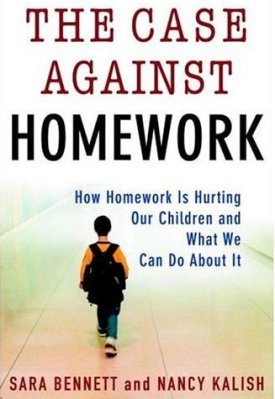 Today on Boing Boing: Cory Doctorow's review of The Case Against Homework by Sara Bennett and Nancy Kalish. He calls it "a fine and frightening explosion of the homework myth: that giving kids homework improves their educational outcome..."
"...all the credible research on homework suggests that for younger kids, homework has no connection with positive learning outcomes, and for older kids, the benefits of homework level off sharply after the first couple assignments...
"...Not that most teachers would know this -- homework theory and design isn't on the curriculum at most teachers' colleges, and most teachers surveyed report that they have never received any training on designing and assessing homework...
"...The stories go on and on, and just when you're ready to throw in the towel and send your kids into the woods to be raised by wolves, the authors supply several long chapters of strategies and sample dialogs for convincing your kids' teachers to ease off on homework, for changing the homework policies in your school district and for rallying other parents to their cause.
"They're not whistling Dixie, either: the authors have gone through this themselves, challenging and changing the homework policies in their kids' school districts. The last section of the book is an activist guide and a postmortem of the strategies they employed. One of the authors, Sara Bennett, is a celebrated civil rights lawyer; the other, Nancy Kalish, is a famous editor and writer of material for parents, especially mothers. One imagines that their school board didn't know what hit them" [full text of review].
More information can be found on StopHomework.com, co-author Sara Bennett's blog. She recommends taking action by signing the petition calling for the dismantling of the "No Child Left Behind" Act at The Educator Roundtable.
Sunday, May 20, 2007
Job Posting: Project Assistant, Lippman Kanfer Institute
JESNA is a continental nonprofit organization that is focused on improving Jewish education through a cycle of learnings, dissemination, and application.
JESNA (www.jesna.org) is seeking a highly-motivated, self-directed individual for a part-time (10 hour per week) position as Project Assistant for its Lippman Kanfer Institute. The Lippman Kanfer Institute operates as a think tank within JESNA, focusing on the identification and diffusion of innovative ideas and practices that will keep Jewish education relevant and effective in the 21st century. The Project Assistant will work closely with the Director of the Institute (who is also JESNA’s Chief Ideas Officer) to manage its initiatives and day-to-day activities.
PRIMARY RESPONSIBILITIESPOSITION REQUIREMENTS:
- Assist the Director in planning the activities of the Lippman Kanfer Institute, including meetings and events, publications, presentations, and other activities.
- Ensure that these activities are implemented effectively and in a timely fashion.
- Manage the Institute’s ongoing communications with key partners and constituents, including members of the JESNA Board and staff, the Lippman Kanfer Family Foundation, individuals working with the Institute on projects, advisers and consultants, Jewish education funders, and other professional and lay leaders in the field of Jewish education.
- Coordinate meetings, consultations, and other events organized by the Institute.
START DATE: September 1, 2007; possible earlier start if candidate is available sooner
- B.A.
- Experience in managing projects and activities in the for-profit or not-for-profit sectors.
- Skills in using word processing, spreadsheet, presentation (Powerpoint) software; skills in using project management, graphics, and web software a plus.
- Personally familiar with and knowledgeable about the Jewish community and Jewish education.
- Ability to communicate clearly and effectively, both orally and in writing, with all levels of management and staff, volunteer leaders, partner organizations, and media.
- Ability to juggle multiple tasks under deadlines.
- Demonstrated resourcefulness, optimism, flexibility, and good humor in approach to project assignments and in working with colleagues and constituents.
- Commitment to JESNA’s values, mission and goals.
LOCATION: JESNA’s New York office
SALARY: $300 / 10 hr. week
APPLICATION PROCESS: Email resume and cover letter with position title in the subject line to Jonathan Woocher, Director of the Institute, at jwoocher@jesna.org.
Thursday, April 05, 2007
"I'll take 'certain decisions' for $200, Alex"
According to an article in today's New York Times (May 5, 2007),
"New York City’s Department of Health and Mental Hygiene is planning a campaign to encourage men at high risk of AIDS to get circumcised in light of the World Health Organization’s endorsement of the procedure as an effective way to prevent the disease.
". . . In three recent clinical trials in Africa, circumcision was shown to lower a man’s risk of contracting the virus from heterosexual sex by about 60 percent. On March 28, the World Health Organization officially recommended that countries adopt the procedure as part of their AIDS prevention plans.
"Peter Staley, a longtime AIDS activist and co-founder of ACT-UP New York . . . said he was “intrigued” by the idea of offering circumcisions but . . . after reading many postings on gay Web sites about the Africa trials, he said he feared a backlash among black and Hispanic men to endorsements of circumcision from white public health officials or gay activists
". . . he said. 'It’s going to sound like white guys telling black and Hispanic guys to do something that would affect their manhood.'"
Scary paranoid aside in AMA article
In Futurism: The Antidote to Chaos, Eric Garland writes:
"Yes, the world is changing quickly. With its promise of chaos and opportunity, it may seem overwhelming. But I have good news for you. Understanding the future, as it affects your decisions, can become an everyday part of the way you think...
"...Exploring the future is about finding a few trends that could change your world and keeping an eye on them on a regular basis. Futuring is about paying attention to both society and technology and asking yourself: 'Yes, but what will this mean in five years? What about ten years?'...
"...Governments use this kind of thinking in a variety of ways. This scary but potentially real scenario is an example of one such application. Terrorism, unfortunately, is on most people’s minds. National governments use futuring to predict the capabilities of the terrorists of tomorrow. They monitor developments in both society and technology to see where terrorists might gain an edge.
"Some forecasts show that the cost of biotechnology will fall far enough that smaller groups could afford to obtain the equipment needed to alter bacteria. Futurists working for the federal government envisioned a scenario in which terrorists might one day genetically engineer a bacterium or a virus that would target Ashkenazi Jews (originally from Eastern Europe) or Japanese people, but it could be any group with a distinct genetic makeup. For this reason, agencies constantly monitor the power of biotechnology as well as any terrorist networks that are showing an interest in science. The goal is to limit the terrorists’ weaponry to homemade bombs and razor blades instead of genetically engineered plagues. In this way, governments are designing policies for biotechnology that allow scientific progress as well as protection for their citizens."
Moving Ahead, a publication of the American Management Association (AMA), is "a monthly e-Newsletter providing management insights and best practices for all business professionals."
Thursday, March 08, 2007
Is "redesign" enough, or do we need more radical changes?
Last fall, JESNA launched the Lippman Kanfer Institute Wiki with some pretty fabulous intentions: To map out "an agenda and strategy for ensuring that Jewish education is maximally effective and relevant in the new century." Predicated on the belief "that vigorous conversation about important issues in Jewish education is itself an important tool for change," the idea of the site is to use the technology of the internet to generate discussion.
The keystone of the site is Jonathan Woocher's article Redesigning Jewish Education, but to my mind the component that has the potential to be the most useful - and controversial - is the list of noteworthy programs. Although the website grants that most have not been "rigorously evaluated," it notes that "many show clear signs of success in terms of participation, longevity, and the positive responses of participants." Currently the site lists 27 such examples of best practices in the field, and encourages the viewer to add others.
The site also hosts an article by Dr. David Ariel on Consumer Choice and Jewish education. He suggests that
"...Jewish education could embrace the TIVO model ... becoming a subscription service that allows consumer choice within a limited range while also pushing new content to consumers based on the pattern of their preferences. What is true in the consumer arena is true in Jewish education: While people know what they want, the successful Jewish educational service will provide what people don’t yet know they want..."
(The final article currently on the site is my own, on Synagogue Schools and Congregational Agendas. Aw, shucks!)
No surprise that I find the idea of generating dialogue around this content exciting -- after all, that's the agenda of this blog as well. But the idea of using a Wiki to host these articles is, I think, a truly innovative way to push for a real negotiation of ideas. Imagine a website that functions like the Wikipedia, in which articles are being written and rewritten by interested parties, who then debate the validity and relative merits of these changes on highly active "talk" pages.
Unfortunately, readers haven't taken the site quite that far. So, rather than being an interactive or collaborative experience, the Wiki is still currently functioning much like any other website.
The real problem, though, is that conversation happens on separate "dialogue" pages, in which all one can view are the topic headers for individual threads. So, in order to encounter gabebabe's critique of Woocher's article, you would first have to pick the correct one of the five separate pages in which there is space to comment, and then click on a subject header that reads "Redesigning is a..." Only once you get to the actual page will you learn that the rest of the header is "...Rehashing of Ill Defined Concepts" [harsh, dude!] . gabebabe writes:
"...We have a working model of how to transform conventional schooling into experiential education that is being used in schools across the country. There are already dozens of schools around the country which have made the commitment to transform their schools into learning environments that challenge their students’ Jewish emotional, intellectual, physical, social and/or spiritual responses through approaches through the philosophy of experiential education. They are doing this in their classrooms in the heart of what we call formal education. What they have already accomplished demonstrates how outdated this article is."
What would make the Wiki a truly unique endeavor would be if gabebabe would add the programs he has in mind to the list of noteworthy programs -- and then explain how they accomplish what the other ones don't. While he's at it, he could critique some of the other interventions that are already listed.
With many others contributing through a wiki-fied give-and-take, including people personally involved in the programs being critiqued, perhaps we would collectively be able to arrive at meaningful criteria by which to evaluate Jewish educational reforms, standards for what we mean by "success," and ideas that can be implemented broadly. As an aside, Shulshopper (currently in beta) has the potential to offer a similar contribution to the world of prayer - if, for example, it were possible to search not only for the synagogues that receive the highest ratings, but also the ones that generate the most discussion (although that's not currently on the to-do list for the site).
I'd love to see the Lippman Kanfer Institute wiki embody one of the five strategic changes that Woocher proposes in his article: To become a "hothouse" for collaborative innovation. A fully utilized wiki could
"...draw considerable attention to the processes of innovation and diffusion ...encourage collaboration among key constituencies that need to work together for change to occur...promote the sharing of information among those involved in change in diverse settings...afford opportunities through collaborative inquiry to deepen and refine our understanding of both specific innovations and the process of implementing new approaches generally."
This would require a redesign of the website, which in truth isn't really set up right now to encourage people to edit the content (although I'd be delighted to see my own article reformatted for this purpose). It would truly be a transformation of its current use into something entirely different and far more risky. And, maybe this is a good analogy for what needs to happen in Jewish education writ large.
Wednesday, December 13, 2006
...and in the news this week...
Brooklyn has more upmarket preschoolers than it can handle, reports New York Magazine in "The Preschooler Glut:"
The brownstone-Brooklyn baby boom is causing a sort of educational crisis in the once easygoing borough, leading parents to wonder: When did this turn into Manhattan? A flood of would-be students has forced the area’s premier preschools (where tuition is five figures) to close their application season as much as three months early.
The Conservative movement's Solomon Schechter day schools are considering changing their bylaws to admit the children of non-Jewish mothers, reports this JTA article. More detailed analysis is offered by the Baltimore Jewish Times. Sue Fishkoff asks in her a follow-up article:
If Solomon Schechter day schools begin to admit children of non-Jewish mothers, will that draw students away from Reform or community day schools? [...] Zena Sulkes, day school specialist for the Union of Reform Judaism, said she does not anticipate an exodus from the 19 schools affiliated with the Progressive Association of Reform Day Schools. Since Schechter schools already quietly admit non-halachically Jewish children, those families looking for a Schechter education are already going there, she suggested. Others won’t be tempted.
Subscribe to:
Posts (Atom)