Dear School Families,During Religious School on Sunday and Monday, we did not explicitly raise the tragic events at Tree of Life Synagogue in Pittsburgh with our students. We know that every child is different, and each family must choose to handle the situation in its own way. Yet, we also know that many of our children have questions and fears that we, as their parents, want to address – not to mention our own, adult concerns.I want to share with you the guidance I gave our faculty, which holds for parents as well:
- If the children bring up the topic, don’t shut it down. Listen attentively to what they have to say -- their concerns and their questions, their thoughts and feelings -- and let that drive the conversation.
- Try to answer questions factually without adding unnecessary details. Don’t assume that your questions and concerns are theirs.
- Reassure the children that Temple Emanu-El is a safe place; we are a sanctuary for all people seeking comfort and support. Here at Emanu-El, there are many adults who are looking out for them and who know exactly what to do to prevent emergencies of all types from happening. A good example is that when there is a fire drill, we all are trained to respond quickly and safely. There are other things that the kids don’t know about that we, the adults, are doing to keep them safe.
- Let them know that an important part of what it means to be Jewish is that when we hear about tragedy, we want to respond. That is why Emanu-El is participating in city-wide vigils (both to express our emotions and to demonstrate our solidarity) and why our Philanthropic Committee and Student Council are already talking about what we can do to help the people of the Tree of Life Community.
- Remind them that there are always many more people trying to be good than to do harm, of all religions, backgrounds, and nationalities. Unfortunately, it is so much easier to be destructive than to build, and bad news always gets the headlines – but remember, although there are some dangerous people in the world, nearly everyone you meet is a kind, generous, loving person like yourself.
Showing posts with label politics. Show all posts
Showing posts with label politics. Show all posts
Wednesday, October 24, 2018
Talking with our children about tragic events
This is what I shared with the Religious School community at Temple Emanu-El after the events at Tree of Life Synagogue:


Saturday, December 15, 2012
Responding to Crisis on the Eighth Night of Chanukah
If,
like I, you are finding yourself speechless after using words like “tragedy,”
“devastation” and “disaster” so many times this fall, you may find some words to say by looking at the Jewish Education Center of Cleveland's “Responding
to Crisis” website.
Some
links you might find particularly useful:
How children respond to crisis
Many
of the quotes in the section “texts
from our tradition” speak to me, but I particularly note one that we have
been teaching our Sunday 3rd-5th graders at Emanu-El:
Who is mighty?
One who conquers his evil impulse.
As it is written,
Those who are slow to anger are better than the mighty,
And those who rule over their spirit than those who conquer a city.
Finally,
many useful links in the resources
section, and I sadly note that this one is helpful to know about right now:
Helping your children manage distress in the aftermath of school shootings
This
being the final evening of Chanukah, I thank all of you reading this for your dedication and
rededication to keeping alive the flames of hope, courage, and faith. At times
like these, I am so proud to belong to a tradition that for thousands of years
has asserted that every human life is sacred and dared us to strive for a more
righteous and more loving society. I know the metaphor of “passing along the
torch” is a tired one, but when you are lighting the Shamash so your kid can
light her menorah . . .
Thanks to Nachama Skolnik Moskowitz for posting a reminder about this resource to the NATE facebook group.
Monday, June 21, 2010
Emanu-El | Weekly Torah Commentary: Balak
I write the Weekly Torah Commentary for the Congregation Emanu-El website about three times a year. This time, I thought it made sense to share it here. Shabbat Shalom.

ach week, we in the Religious School begin our worship services with the students by singing the words from Numbers 24:5, “How good are your tents, Jacob, your dwellings, Israel!” These are the words that traditionally begin morning daily worship, said upon first entering a synagogue. The word “dwellings” might also be translated as “sanctuaries,” and it is fitting that we begin our prayers with words of appreciation for the space in which we will offer our prayers.
In their original context, in this week’s Torah portion, these words are spoken by the prophet Balaam, who has been hired to curse the Israelites by Balak, the king of Moab. Balak has seen the victories of the Israelites against other nations as they have traveled in the desert, and he fears that this soon will be the fate of his own kingdom. But Balaam finds himself only able to offer words of blessing, and it is these words of praise, first spoken by a non-Jew, that now are part of our daily liturgy.
When we teach our students about this prayer, we ask them to offer a compelling explanation for what we could possibly mean when we say the word “Israel” in this prayer. Some say that this prayer is a wish for the well-being of the people who live in Israel today, whether Jewish or not. Others note that the prayer also mentions Jacob and argue that this is a prayer for all of those descended from him — all Jews, everywhere. Still others observe that Jacob’s name was changed to Israel after wrestling with an angel, so this prayer is a reminder that we must grapple with the Divine when we pray.
This prayer has been a sort of “theme song” for our two congregational family trips to Israel, in July 2008 and this past December 2009 – January 2010. Shortly after arriving, we sang these words while standing on a hilltop in Jaffa, looking out on the city of Tel Aviv. I tried to imagine how all of the people living in every apartment complex and villa are trying to make a good and beautiful place for themselves and their families. A few days later, while visiting a mountaintop kibbutz overlooking the Lebanese border, I looked out towards the houses on the other side of the valley separating the two countries. I thought to myself, if only the people living on each side of the border could look to the other and offer words of blessing: How good, how beautiful, is the place where you live.
On our final night in Jerusalem, just before heading to the airport, we again sang these words while looking out at the Old City, divided into four quarters like the four chambers of the human heart. It is to this spot that we turn when we pray, reminding ourselves that the heartbeat of Jerusalem has kept the Jewish people alive throughout the centuries. Yet, here too is where Jesus walked and, some say, was resurrected; where Muhammad is reported to have ascended to heaven; for Christians and for Muslims, as for us, Jerusalem is the beating heart of a people.
We teach our students that there isn’t a single correct answer as to what we mean when we say “Israel” in these words. But I know that for me, I agree with all three of these answers. I am praying for the beautiful homes of the Jews, my people, my own ancestry. I am praying for the good homes of the people living in Israel, whatever their religion may be. And I am grappling with the Divine and wondering when will the time come that enemies will turn to one another and find themselves only able to offer words of blessing.
Balak (June 26, 2010)
Translation: Numbers 24:2-5 (2) As Balaam looked up and saw Israel encamped tribe by tribe, the spirit of God came upon him. (3) Taking up his theme, he said: Word of Balaam son of Beor, Word of the man whose eye is true, (4) Word of him who hears God’s speech, Who beholds visions from the Almighty, Prostrate, but with eyes unveiled: (5) How fair are your tents, O Jacob, Your dwellings, O Israel! Excerpted from The Torah: A Modern Commentary, Revised Edition, editor W. Gunther Plaut (NY: URJ Press, 2005). Used by permission of URJ Press, www.urjbooksandmusic.com. | Original Text:  |
Commentary
 |
Saul Kaiserman, |
In their original context, in this week’s Torah portion, these words are spoken by the prophet Balaam, who has been hired to curse the Israelites by Balak, the king of Moab. Balak has seen the victories of the Israelites against other nations as they have traveled in the desert, and he fears that this soon will be the fate of his own kingdom. But Balaam finds himself only able to offer words of blessing, and it is these words of praise, first spoken by a non-Jew, that now are part of our daily liturgy.
When we teach our students about this prayer, we ask them to offer a compelling explanation for what we could possibly mean when we say the word “Israel” in this prayer. Some say that this prayer is a wish for the well-being of the people who live in Israel today, whether Jewish or not. Others note that the prayer also mentions Jacob and argue that this is a prayer for all of those descended from him — all Jews, everywhere. Still others observe that Jacob’s name was changed to Israel after wrestling with an angel, so this prayer is a reminder that we must grapple with the Divine when we pray.
This prayer has been a sort of “theme song” for our two congregational family trips to Israel, in July 2008 and this past December 2009 – January 2010. Shortly after arriving, we sang these words while standing on a hilltop in Jaffa, looking out on the city of Tel Aviv. I tried to imagine how all of the people living in every apartment complex and villa are trying to make a good and beautiful place for themselves and their families. A few days later, while visiting a mountaintop kibbutz overlooking the Lebanese border, I looked out towards the houses on the other side of the valley separating the two countries. I thought to myself, if only the people living on each side of the border could look to the other and offer words of blessing: How good, how beautiful, is the place where you live.
On our final night in Jerusalem, just before heading to the airport, we again sang these words while looking out at the Old City, divided into four quarters like the four chambers of the human heart. It is to this spot that we turn when we pray, reminding ourselves that the heartbeat of Jerusalem has kept the Jewish people alive throughout the centuries. Yet, here too is where Jesus walked and, some say, was resurrected; where Muhammad is reported to have ascended to heaven; for Christians and for Muslims, as for us, Jerusalem is the beating heart of a people.
We teach our students that there isn’t a single correct answer as to what we mean when we say “Israel” in these words. But I know that for me, I agree with all three of these answers. I am praying for the beautiful homes of the Jews, my people, my own ancestry. I am praying for the good homes of the people living in Israel, whatever their religion may be. And I am grappling with the Divine and wondering when will the time come that enemies will turn to one another and find themselves only able to offer words of blessing.
Friday, August 21, 2009
Dawn of the Chimpanzee! (Relax, folks, they're just a metaphor)

Hurray for Eli Valley, and for Makom and Ha'aretz being brave enough to post this comic onto their website, writing:
"More than its blunt critique of Israel, Israeli policy, and Israelis, the cartoon points an accusing finger at all aspects of the Jewish establishment of the United States. Eli Valley is clearly no outsider to the Jewish community. The cartoon jabs at Jewish schools, camps, Israel advocacy programs, and even pokes fun at a sociologist whose work is well-known in the Jewish world. Valley himself is a regular cartoon contributor to The Forward newspaper.
We may disagree with the cartoon's sentiment, but we cannot accuse it of ignorance."
Here's the link to the comic, Dawn of the Chimpanzee!, in its original home on Gawker, where the comments forum is surprisingly thoughtful.
Thanks to Alex Sinclair for the tip-off on this. Voonga...Voonga!!
Thursday, November 06, 2008
Get Paid to be Jewish? Part 2
Do you remember way back when, when I blogged about Moishe House, with a quote from the JTA:
"Say you’re a few years out of college, living with friends and working in a low-paying job for some do-good organization. You don’t go to synagogue but you miss the camaraderie of your college Hillel, and you like to invite people over for Shabbat meals.
"Imagine if someone was willing to pay you to keep doing it?"
Well, Ben Murane has thrown down on birthright NEXT's similar initiative on Hazon's Jews-n-food blog "The Jew and the Carrot," under the heading "Do We Need to Pay Birthright Alumni to Have Shabbat Dinner?"
"Once again, the organized Jewish community has decided to answer the droopy quality of Jewish life offerings with a marketing campaign and financial largess. I think NEXT’s money is mispent."
Now, what makes this such a tremendously worthy read is that the very first response to Ben's post is from none other than Birthright Israel NEXT Executive Director (and fellow blogger) Daniel Brenner:
" . . . we are proud that through small grants that we have been able to encourage over 600 people across the country to host meals in their homes. For a majority, it has been the first time in their life that they hosted a Shabbat meal. So far, 74.6% of those meals have been homecooked by many hands. Most people had 14 guests! We sponsored many vegan shabbats, raw food shabbats, organic shabbats, you name it. And good food is often not cheap — and not everyone has the luxury of being near a farmer’s market. And not everyone has the time or skill to cook!
"Could we do it for $15 per person? maybe so. But we felt that $25 per person would make for a special meal.
"By the way, we are also providing financial assistance for Birthright Israel alumni to attend the upcoming Hazon Food Conference. We do so because we have found that in these economic times, people in their twenties do not have alot of spare change to go to Jewish confereces."
But wait! Who is the next comment from?
"Don’t worry, Rabbi Brenner. I’m hosting plenty of birthright NEXT shabbat dinners at the apartment I share with Mr. Murane . . .Read the whole fun debate, and then get yourself some excellent baby swag, at The Jew and the Carrot.
". . . The money isn’t an incentive for me to host a dinner. It’s an *enabler*. Big difference."
Saturday, April 07, 2007
Why should Jews care about a bike ride?
This May, I will join with 179 other riders in a 300-mile, 5-day ride from Jerusalem to Eilat.

I hope that everyone reading this needs no convincing that we are currently dealing with a wide variety of extremely serious environmental concerns that will have long-lasting impact upon the planet. For me, for religion to have any meaning at all, it must be able to provide guidance in responding to such pressing issues. I believe that the Jewish tradition indeed provides a starting point. Here are three such ideas:
1. Blessings (“Brachot”). We are taught to have a moment of reflection and appreciation before and after eating, connecting ourselves with the whole process by which we are nourished -- a process which involves many people across the world and responsible care for the planet that provides our food. We are also taught to say a blessing each time we hear thunder, see an ocean, smell fresh fruit . . . in fact, our days are filled with opportunities to make a connection with the natural world around us, with awe and gratitude.
Abraham Joshua Heschel taught that "prayer is meaningless unless it is subversive;" each time we say one of these blessings can be an opportunity to take our gratitude one step further by taking responsibility. These blessings can be a call to social justice and accountability.
 2. The Stories of our People. Call them the Jewish identity-myths if God-talk makes you roll your eyes, but they still contain important truths that don't get trivialized in the retelling. To give just one example: Noah's ark. The whole 2 of every species thing asserts the importance of biodiversity; building the ark and bringing on the animals is a metaphor for our responsibility to be the caretakers of that biodiversity.
Certainly, not every Jewish story sounds like something written by Greenpeace, but there are enough to fill up a Sunday School curriculum. To me, I'd prefer it if my Jewish education taught me that for centuries upon centuries, at least some of my ancestors cared enough about the environment to pass along these stories.
3. Ethics. I don't think I am speaking out of turn when I say that for all of us who were in youth group together, tikkun olam (repairing the world) is central to our understanding of why be Jewish instead of nothing at all. We care about making the world a little bit better for ourselves and for others. There are a whole medley of Jewish concepts that cover environmental issues, and they weren't invented at the first Earth Day celebration in 1970.
For example, the concept of "bal tashchit" (not senselessly wasting) demands that we weigh our pressing human needs (for comfort, security, convenience) against a larger backdrop of their impact on others and upon the planet (resource depletion, destruction of beautiful places, creation of health hazards). It isn't a stretch to think about reduce/reuse/recycle" in this context. The beauty of it, to me, is that there isn't a prescriptive answer - just an obligation to take responsibility, to be conscious that the impact of our actions is often greater than we realize - and so to act carefully and with consideration. Now, you may be thinking at this point, all that's great, but what does it have to do with a bike ride? Well, the bicycle is a terrific, non-polluting form of transportation. Part of it, I think, is just that a whole bunch of people doing a long bike ride attracts attention - and raising awareness about environmental issues is a key concern here in Israel. Part of it, for sure, is the whole "a-thon" philosophy (can he really do it? I'd pay money to see him get on a bike for that length of time!). And, also, it's just a gimmick to bring together people who care about the environment and care about Judaism.
The thing is, though, it’s a gimmick that works: Hazon has been incredibly successful at building community among Jews with an incredible range of political and religious sensibilities. For a great number of those people, Hazon is the only “Jewish” thing in their lives. It seems self-evident to me that Judaism ought to be concerned with the quality of the air, water, and earth in the “Holy Land.” The Hazon Arava ride is more than a means for raising awareness – and funds – for Israeli environmental issues. Because the ride brings together Israeli Jews and Arabs as well as Jordanians, Palestinians, and people from other countries, it provides an opportunity for people who care about this land to come together on an issue of mutual concern. I believe that working together to build a livable natural environment in the Middle East and fighting for environmental justice provides a key opportunity to work towards resolving the political and social problems of the region.
I’m proud of the fundraising I have done for Hazon in the past and I hope you will consider making a tax-deductible donation to the ride.
Thursday, April 05, 2007
Scary paranoid aside in AMA article
In Futurism: The Antidote to Chaos, Eric Garland writes:
"Yes, the world is changing quickly. With its promise of chaos and opportunity, it may seem overwhelming. But I have good news for you. Understanding the future, as it affects your decisions, can become an everyday part of the way you think...
"...Exploring the future is about finding a few trends that could change your world and keeping an eye on them on a regular basis. Futuring is about paying attention to both society and technology and asking yourself: 'Yes, but what will this mean in five years? What about ten years?'...
"...Governments use this kind of thinking in a variety of ways. This scary but potentially real scenario is an example of one such application. Terrorism, unfortunately, is on most people’s minds. National governments use futuring to predict the capabilities of the terrorists of tomorrow. They monitor developments in both society and technology to see where terrorists might gain an edge.
"Some forecasts show that the cost of biotechnology will fall far enough that smaller groups could afford to obtain the equipment needed to alter bacteria. Futurists working for the federal government envisioned a scenario in which terrorists might one day genetically engineer a bacterium or a virus that would target Ashkenazi Jews (originally from Eastern Europe) or Japanese people, but it could be any group with a distinct genetic makeup. For this reason, agencies constantly monitor the power of biotechnology as well as any terrorist networks that are showing an interest in science. The goal is to limit the terrorists’ weaponry to homemade bombs and razor blades instead of genetically engineered plagues. In this way, governments are designing policies for biotechnology that allow scientific progress as well as protection for their citizens."
Moving Ahead, a publication of the American Management Association (AMA), is "a monthly e-Newsletter providing management insights and best practices for all business professionals."
Monday, March 26, 2007
Seder Suggestion: An Empty Chair for Darfur
Rabbi David Levin-Kruss offers this idea (which has generated some controversy on the Lookjed discussion group):
Like many, I watch the events unfolding in Darfur and wonder what I can do to help.This year I have decided to use our Pesach seder as a way to further the cause and I suggest you do the same. Rather as in the days of the Soviet Jewry movement I propose that we leave a chair empty for those in Sudan and donate the cost of one meal to a charity working to alleviate and change the situation. We could also ask our guests to donate rather than to bring gifts.
In the Vehee She'amda prayer in the haggadah we read that in every generation others have stood against us to destroy us, but the blessed Holy One saved us. This is an appropriate point to say something along the following lines:
"In this prayer we read that we are and have been persecuted. Let's remember that we are not the only persecuted in the world and that others suffer too e.g. those in Darfur. Let us pledge today to act as G-d's mouth and hands by speaking truth to power and doing what we can (politically, militarily, financially, and personally) to bring about a better situation. Let us hope that next year we will not need to leave a chair open to mark those who do not share the freedom we have."
For more information about what is happening in Darfur and what you can do, check out these resources from Raising Awareness Destination: Darfur (RAD:D), founded by High School student Sarit Rosenstock and hosted by Areyvut. Organizations seeking funds for relief and advocacy efforts include American Jewish World Service (AJWS), the Jewish Coalition for Disaster Relief (JCDR), Jewish World Watch (JWW), and the Save Darfur Coalition.
This final organization makes it possible to take immediate action by sending an email to President Bush.
Wednesday, December 06, 2006
Israeli textbooks, the Green Line, and Yuli Tamir
 It is well known that many textbooks in use in the Middle East fail to show Israel on their maps, as for example in this map from a 4th grade Syrian civics textbook. Or Kashti reports in today's Ha'aretz that:
...on the Web site of the Israel Defense Forces intelligence division, in a section dubbed "the hatred industry," the site analyzes the textbooks distributed by the Palestinian Authority. The writers point out that the maps do not mention Israel's name. They complain that when the Green Line is marked, Israel and the territories are shown in the same color. That is one of the "sophisticated methods of bypassing the problem," the site says [link to the report that Kashti cites, by Dan Meridor].What you may not know, however, is how the state of Israel is presented in maps in Israeli textbooks. In the same article, Kashti reports on a two-year old study by Dr. Nurit Peled-Elhanan of the Hebrew University's School of Education:

Peled-Elhanan examined six textbooks published after the Oslo Accords, including some that were officially sanctioned by the Education Ministry. Other books were adopted by many teachers even though they were not officially approved. Among the salient findings were the blurring of the Green Line, the ignoring of Arab towns in Israel, and the presentation of sites and settlements in "Judea and Samaria" (not the "West Bank") as an integral part of the State of Israel.
[editor's note: the map to the left is not, of course, from an Israeli textbook, but from YeshaHomestead, a site devoted to building settlements on land purchased from Arabs. If you should happen to be Haredi, rich, and willing to gamble on the future of settlements on the West Bank, you might be interested in purchasing a "big house" or a mansion in the mountaintop community of Givat Yakov. But I digress...].
 This week, Minister of Education Yuli Tamir propsed that all maps in new editions of Israeli textbooks show the Green Line, and she wants the next budget to support private publishing companies in making the change. Akiva Eldar reports in Ha'aretz:
Tamir said Israel could not demand of its Arab neighbors to mark the June 4, 1967 borders, while the Israeli education system erased them from its textbooks and from children's awareness. "This is not a political issue, but rather an educational one," Tamir said Tuesday. "We teach, for instance, about United Nations Resolution 242, but we don't show students the Green Line. We cannot deny that there used to be a border that is still being debated today." Tamir defended the decision as the only way to teach students the basis of the region's politics.
Meanwhile, an organization of right-wing rabbis on Tuesday issued a Halakhic decree forbidding students from using schoolbooks featuring maps of Israel which include the pre-1967 Green Line border, Israel Radio reported.
Tamir's decision may indeed be partially political, but Or Kashti reports in another article that there is a pedagogic basis for the change: An improvement in the teaching of geography in Israel:
Education Ministry officials in charge of the subject are convinced the only way to make geography relevant and strengthen the subject's standing is to add current issues to the lessons - for instance, by marking the Green Line in school textbooks and on maps.
A new curriculum for 10-12th graders, which addresses the Green Line much more extensively, is set to be introduced in the next school year. In the new curriculum, students will discuss "the factors in the delineation of Israel's borders," including the 1967 Six-Day War, as well as "different approaches for delineating final borders."
The curriculum will present three primary approaches: a return to the 1967 boundaries, preservation of "Greater Israel" and various proposals for border adjustments and compromise. The students will be expected to recognize and understand the "different approaches for defining the borders of the Land of Israel and the State of Israel."
"The question of borders will become an issue that is debated in the classroom," said [Education Ministry's supervisor-coordinator for geography studies, Dalia] Panig. "The education system should not bury its head in the sand. There is a constant debate in Israeli society regarding the different approaches to determining the borders, and there is no reason it shouldn't take place in the classroom. It is unacceptable that a student should hear terms like 'the Green Line' and not recognize them.
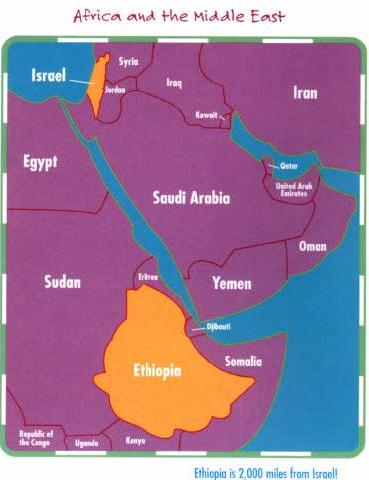
As in Israel, many of the maps and textbooks that are in wide use in liberal Jewish settings in the United States don't demarcate the West Bank, Gaza Strip, or Golan Heights in any way. For example, take a look at this map from Behrman House's 4th-6th grade textbook "Welcome to Israel".
The chapter from which the map is taken addresses the diverse population of the State of Israel. It notes that Israel is home to one million Arabs and to a variety of religions that consider it a holy land. It asks readers to ponder questions of the nature of a "Jewish state," such as whether non-Jews should be able to hold Israeli citizenship and whether the prime minister should be a rabbi. It even includes a photo of Rana Raslan, the first Arab Israeli to be crowned Miss Israel [a kindergarten teacher, incidentally], and quotes her as saying "...it does not matter if I am Jewish or Arab, I will represent Israel as best I can." In short, the chapter does a fine job of depicting the pluralistic nature of the State of Israel and the questions such diversity raises. Yet, in the map accompanying the chapter, it is clearly "greater Israel" that is shown.
How does your school or educational program handle the question of maps of Israel? Do the textbooks you use or the maps you hang on the wall show the Green Line? Do you "problematize" the question of borders, as the Israeli Education Ministry now intends to do with its High School students? If you aren't clear on the answers to these questions - may I suggest that this is a good opportunity to take a second look at your materials, and to enter the same debate that Yuli Tamir has raised here in Israel.
Friday, November 24, 2006
Will Left Behind be left on the shelves?

Released in time for Christmas, the apocalyptic Christian-themed video game that stirred up the Jewish Week (see "Jewish Week not Pleased to be Left Behind") isn’t exactly receiving rave reviews.
Citing game-play design problems, the need for too much micromanagement, and weak graphics, ign.com rates it a 5.9, “Mediocre:”
In any case, the controversy about the game's message has been overinflated somewhat. Given the wide range of games that are inspired by religious, mythical and supernatural beliefs, it's interesting to see a game that presents the concepts of a modern religion like Christianity as core components of gameplay. True, the very idea that converting non-believers is the central activity in the game is likely to alienate some people but it really shouldn't be much of a surprise to people that a game with a picture of an angel and a warning about the antichrist on the box is going to have a Christian slant.
Underground Online gave the game a more generous B+ rating, finding it repetitive and a little dull:
When you give an order to your units, almost half of your Friend and Recruiter units' responses will be "Praise the Lord!" Which can get annoying to hear 50 times a minute.
This review also pointed out one of the more bizarre aspects of the game - rappers and heavy metal musicians are the enemy! (sorry, Corner Prophets. Well, I guess Ismar Schorsch might enjoy the game...):
As we mentioned before, the streets are filled with rappers, and anyone in your Force has to steer clear of them. Any person who walks too close to a rapper will hear their rap song, and anyone who hears a rap or heavy metal song will have their Spirit level lowered. So if you see a rapper or heavy metal musician, you can either shoot them dead to protect your people's faith, or counteract them with your gospel singers or other spiritual warfare units, who raise people's Spirit levels.
Finally, Just Adventure rates it a C+ but their review does offer a concise summary of Christian eschatology.
Friday, October 20, 2006
Jewish Week not pleased to be "Left Behind"
If last month's report on computer games on the Palestinian-Israeli Conflict wasn't sufficiently weird for you, then this article entitled "Jews in the Virtual Cross-Hairs" from the current Jewish Week might satisfy:

Based on the wildly popular Evangelical “Left Behind” book series, which details the struggle between good and evil once the Rapture occurs and true believers in Christ are whisked away to heaven, the game is due out early next month and poised, some industry analysts say, to sell hundreds of thousands of copies. As members of the Tribulation Force, the game’s protagonists, the player must roam the streets of a carefully rendered Manhattan and interact with passers-by, many of whom come equipped with “life stories” stressing their biography and spiritual state.
New York being New York, a large number of these computer-generated characters are Jewish. One of the game’s major goals is to convert as many of these characters, winning them over to the side of good. Although the game doesn’t mention Christ or Christianity specifically ... [it] offers, as a reward for completing each level, the opportunity to be directed to a Christian ministry’s Web site.
Being the computer geek that I am, of course I had to see how the game is described on Gamespot, a major site for reviews and insider previews of computer games. You can get a pretty good feel for the vibe of the game from the offical trailers, but their preview notes some unusual features of the game, such as:
- "Like many real-time strategy games, Eternal Forces features a variety of resources that you need to accumulate to build units. One of these resources is your spiritual rating, which measures how good or evil you are. If your troops kill civilians and innocents, your spiritual rating drops, and if it drops too much, you may see your units defect (each unit has his or her own spiritual rating), and if drops too far, demons will show up."
- "The game will feature biblical facts between levels, accompanied by tracks from Christian rock groups" (with in-game links to let players buy songs from iTunes).
- "While you will play the single-player campaign from the perspective of the good guys, the multiplayer will let you play as either side. This will raise some eyebrows among some of the game's audience, but Left Behind Games felt it was important to represent both sides in the game."

The note that this is a "game that most people will have an opinion about, even if they never play it" is borne out by the user comments, which make the Ha'aretz discussion groups look tame (see the next article, below). The game is due to ship in mid-November. PS: I love the Gamespot mention that the game includes "Biblical facts."
Ha'aretz: Censorship on behalf of public discourse?
 What happens when public discussion forums get a little out of hand? The English-language website for Ha'aretz has offered one approach with the publication of new guidelines for certain "talkback" articles. Bradley Burston explains:
In theory, the virtual no man's land of cyberspace affords a unique chance for common ground. But no. If anything, the Internet has become a powerful new weapon, widening to the ends of the earth the dimensions of the battleground in the Middle East conflict, exacerbating tensions and sparking new bloodshed with incendiary footage of atrocities real and doctored.
On a day-to-day basis, the battle is joined with gladitorial abandon, fervor, and bloodletting in the arena of the Talkback. More's the pity, since it is in the forum of the Talkback, more than anywhere, that a meeting of well-intentioned hearts and minds could truly take place.
In practice, Talkback forums have all too often served to provide a platform for the bully, the snide verbal abuser, the lockstep ideologue with no tolerance for the opinions of others. The reader sincerely interested in communicating with the other side may well refrain from responding, repulsed by the crude remarks of respondents who have found in Talkbacks a satisfyingly larger potential audience than they would have, had they scrawled the same thoughts on the side wall of a public toilet.
Writing that "censorship will be unapologetic" but that "political orientation will have absolutely no bearing on whether a comment is posted or rejected," criteria for deletion include racist remarks and slurs, comparisons of either Israeli or Arab policies with those of the Nazis, profanities directed at others in the forum, advocacy of violence, and "use of the phrase: 'There are no Palestinians' or derivatives thereof."
From my perspective, this seems to be a reasonable way of trying to create a forum for dialogue. There is a role for facilitation by a moderator, after all -- even if just to prevent a conversation from being dominated by one contributor. I have, for example, had no hesitation when deleting comments left by contributers that consist of nothing more than links to spam sites and do nothing to further discussion of, really, anything at all. Nevertheless, I'm curious whether readers of this blog see this form of Net censorship as a postive step or as overly intrusive.
Tuesday, October 03, 2006
Kinky Friedman . . . Good for the Teachers!
Kinky Friedman, the Jewish cowboy/folk-singer/mystery-novel writer and independent candidate in the Texas gubernatorial race, was quoted in The Pine Log (Austin State University's newspaper) as advocating the legalization of gambling in Texas in order to raise teacher's salaries. Staff writer Jesse Williams writes:
He said teachers had the most important job but are paid $6,000 below the national average. Friedman said gambling would bring $8 billion for teachers. Texans must go out of state to gamble. "We invented Texas Hold'Em, and we can't play it," he said.
Besides teacher's pay, he also said that what teachers instruct students should change. He said that Texas is one of the richest states but has the poorest student grades. Friedman said students should be taught things other than what's on the TAKS test. "We've created a generation of kids who don't know if the Civil War was here or in Europe," Friedman said.
With the campaign slogan "why the hell not?," it is hard to imagine how any dissatisfied Texan voter could resist voting for the man who wrote "They ain't making Jews like Jesus anymore." But if you'd like to be convinced a little more, check out one of his cartoon campaign messages on myspace.
UPDATE (10/3): Thanks to BZ for alerting me that Kinky might not be an all-around ideal candidate -- I'm not so comfortable with certain remarks that he claims were made satirically about Katrina refugees, for example, and he has some disconcerting views about illegal immigration and school prayer.
Of course, one might find the idea of using gambling proceeds as a way to pay for teacher's salaries troubling in the first place.
Monday, September 11, 2006
And now a word from the Elders of Zion...

The Jewish People Policy Planning Institute (JPPPI) has released its 3rd annual "assessment of the situation and dynamics of the Jewish people," which can be downloaded as a .pdf file here. The report makes a number of policy recommendations, most of which are in-line with the primarily conservative agenda of the organization, such as:
Some of the key points in their 2006 report include:"Once a democratic decision is taken by Israel; its choices should be supported by the vast majority of Jewish People organizations and leaders, whatever their views may have been before that decision."However, the report also encourages investment in the use of cyberspace for learning and community building and, even more importantly, the support of grassroots initiatives "as a main recommended strategy." They specifically recommend giving financial priority to youth group initiatives, providing training and support to "would-be initiators," and to "take care to respect and encourage the autonomy of grass roots activities." Yippie!
- Israel is now the largest Jewish community in the world, with a population of 5,309,000. The United States has a population of 5,275,000 (although with the caveat that this does not include "non-Jewish members of Jewish households"); the rest of the world, combined: 2,501,000 Jews (primarily in France, Canada, Russia, the United Kingdom, or Argentina). As Dennis Ross writes:
"If nothing else, this means that the future of the Jewish people is more clearly linked to the fate of Israel, and Israel’s character, values and security will matter even more to those who live in the Diaspora."
- "As opposed to a previous attitude of generic condemnation of genocide," 2006 saw the beginnings of the "acknowledgement of the Shoah as a major event in European and world history," as demonstrated by (for example) the declaration of an International Day of Holocaust Remembrance by the United Nations, the establishment by most European countries of a European Day of Memory on January 27, and the opening of several "highly visible Shoah Memorials, notably a large one in Berlin."
- 39% of American Jews use the Internet for Jewish purposes (although its not clear how many of these are referring to J-Date).
Subscribe to:
Posts (Atom)