Monday, February 26, 2007

Playing with Dolls

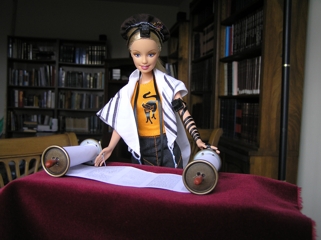
Jen Taylor Friedman's "Tefillin Barbie" broke out of the blogosphere to appear in Jewish Week this past week.

If you're bummed that yours is on back-order, or troubled by her wardrobe choices, check out the Gali Girls, "Jewish dolls for Jewish girls," three of which are paired with a supporting curriculum.
"The Gali Girls Jewish History Series is a fun and informative way to teach students about the cultures, traditions, and beliefs that the Jewish people have held in their respective countries and communities across the globe and across the ages.

"We offer a FREE SAMPLE CURRICULUM with your purchase of any Gali Girls Jewish History Series book. Gali Girl dolls are also available to add depth and character to each story, and they also make a fun addition to your classroom's Shabbat celebration!"

Either way, I think both would make a great companion for those mini-Torahs that you get on Simchat Torah every year.

To tie this all together, here is a list of ideas for playing with your mini-Torah, originally created for a family education program at Central Synagogue in NYC.

Older readers, on the other hand might, be best served by the Sigmund Freud hand puppet, which comes, of course, with a couch.

Saturday, February 24, 2007

Top 5 Reasons Hebrew School Sucked

According to the current issue (Winter 2007) of New Voices Magazine:

5. All they teach you is that other people suffered and died, and that is why you should eat your grandmother's brisket

4. School from 4-6 o'clock = missing TGIF re-runs circa 1989

3. School on Sundays means you can't sleep in and you miss football

2. Hebrew school teachers seem to want to be there even less than their students

1. Hebrew school challah is the absolute worst

Published since 1991 by the independent, non-profit, student-run Jewish Student Press Service, New Voices is America's only national magazine written by and for Jewish college students.

Sunday, February 11, 2007

Remembering Florence Melton

The great champion of Jewish education, Florence Z. Melton, passed away last week at the age of 95.

She was best known for her work with adult education through the Florence Melton Adult Mini-School, a pioneering program that has impacted on close to 30,000 adults. Based around an intense two-year curriculum and taught by outstanding educators, the Melton Mini-Schools paved the way for other serious adult learning programs (such as Me'ah). The Melton Mini-Schools comprise the largest pluralistic adult Jewish education network in the world, with over 60 sites located throughout the United States, Canada, the United Kingdom and Australia. More recently, they adapted the curriculum for the "Parent Education Program," whose goal is to show how concepts learned in class are relevant and applicable to the students' lives as Jewish parents.

Alongside her work in adult education, she also was, in the words of Rabbi Steven M. Brown (Dean of the Davidson School of Jewish Education), "a fierce advocate for the synagogue school. She saw it as one of the most important vehicles for Jewish education even in the face of a growing day school movement."

Ms. Melton was not only an entrepreneur, an inventor, and a philanthropist, but also a yoga teacher. In 1994, at the age of 82, she became Bat Mitzvah at Congregation Tifereth Israel in Columbus, Ohio. That same year, she wrote:

I’ve reached the age of eighty-two
And still look for a great tomorrow
But – don’t forget the here and now
For tomorrow is only borrowed.

May her memory be a blessing, and an inspiration, for us all.

Friday, February 09, 2007

Synagogue Schools and Congregational Agendas

Appearing in the January 2007 issue of Sh'ma, on the topic of Synagogue Organizing, is an article that I authored entitled "Synagogue Schools and Congregational Agendas." In it, I propose that a synagogue's education program may be the ideal place in which congregants can examine, challenge, and impact upon the synagogue's institutional vision. I further claim that this approach to education can revitalize and reinvigorate the function and purpose of the supplementary school and of bar and bat mitzvah:

". . . If we want congregants to see themselves as stakeholders in the success of the institution . . . there must be potential not only for the lives of the learners, but the practices of the synagogue itself, to be transformed through learning.

The [key purpose of the] supplementary school . . . is to transform young people into Jewish adults, able to make decisions informed by Jewish values and to knowledgeably and competently participate in Jewish observances. This can only happen when synagogue schools provide students opportunities to engage in learning that is informed by their lives outside the school. If not, anything they are taught will come across as irrelevant. All too often, though, students discover instead that their ideas have no place in the synagogue and, equally, that synagogue’s norms have no place in their lives once they walk out its doors.

". . . In many congregations, bar and bat mitzvah has become the point at which students end their participation in the school and the synagogue, and often, Jewish life. But what if the bar or bat mitzvah ceremony were reframed as an authentic demonstration of mastery of the skills that the synagogue expects of all its adult participants? Becoming bar or bat mitzvah would then require the young adult to share in the responsibility for the community’s outcomes and practices — not only by attending congregational worship or participating in its social action activities, but also by having a voice in setting its agendas."

Many thanks to Susan Berrin and to Sh'ma for permission to post the article in full. I would be delighted to read and respond to any feedback posted here.

Wednesday, February 07, 2007

A Good Week for Tikkun Olam

Hot on the heels of their merger with the Shefa Fund last year, on Monday Jewish Funds for Justice (JFSJ) announced that they will merge with Spark: The Partnership for Service. This merger brings together, on the one hand, one of the major players in the movement to make social justice a normative part of the Jewish experience, and on the other, one of the most exciting, innovative, and successful social justice programs - with a particular focus on teen experiences. See, for example, their chart of the "ten elements of high quality Jewish service learning."

Spark runs three main programs, as described succinctly in their press release:

The Baltimore-based Spark was founded in 2000 to inspire a commitment to service as an ongoing part of each person's life and an important expression of Jewish identity. Thousands of students have participated in one of Spark’s three signature programs.
  • HeartAction provides intergenerational service to the elderly and the ill.
  • LiteracyAction creates ongoing relationships between educationally at-risk elementary school students and volunteers from Jewish groups.
  • Nitzotz, a four year-old summer program and partnership with BBYO, provides an intensive two week residential Jewish service learning experience for teens from across the country.

On the JFJS blog jspot.org, Mik Moore writes that JFSJ had only recently begun to experiment with service learning trips, and this merger will greatly expand their ability to create such opportunities:

"It is impossible to travel to the Gulf Region, meet with people whose lives remain in turmoil, hear from local organizers, and not be moved to action. Integrate serious Jewish learning into the trip - as we do - and service has the potential to be transformative. Our expectation and intention is that service learning volunteers will become advocates and organizers, perhaps active in congregation-based community organizing through their synagogues."
The press release also quotes Michael Steinhardt, one of the five primary funders of Spark, extolling the benefits of the merger: “We are excited that the merger will enable us to take Spark’s innovative pilot to a larger scale."

This has been a good week for Steinhardt's initiatives -- the JTA reported yesterday that "America’s third wealthiest man" Sheldon Adelson "pledged $25 million to birthrightisrael." This donation will enable the organization to double the number of free trips to Israel that it offers Jewish youth.

The above image, by the way, comes from the Ziv Tzedakah Fund website. In addition to their incredible and ground-breaking work as a collective, they also provide a wide range of educational materials, ranging from a curriculum on mitzvot and tikkun olam to an inspirational educational video featuring Israeli "mitzvah heroes."

Friday, January 05, 2007

"Do-it-Yourself" Jewish Education gaining momentum?

In an earlier post (Who Will Teach the Kids of Hadar?), I suggested that as parents try to find solutions for educating their children outside of day schools and synagogues, Jewish homeschooling and volunteer-led initiatives would be two trends to watch. I also suggested that "the participation of professionals and experts as community organizers and curriculum developers may be critical for the success of this do-it-yourself approach." Finally, I pointed out the need for outside funding to enable such initiatives to work. Three months later, I see signs indicating that I may be right on all counts.

One of the early promoters of a "do-it-yourself" approach is Douglas Rushkoff, the author of Nothing Sacred: The Truth About Judaism and the promoter of the concept of "open-source Judaism." His "open source haggadah" was an exciting first step from the (now defunct) Open-Source Judaism Project: An internet-based resource for creating your own haggadah using "scripture, translation, commentary, songs/readings, rituals, and/or illustrations" based on public-domain contributions. Sadly, "... at this time, no further development work will take place on OSH itself; however the site is mostly functional."

"... Though we share with our site's innumerable visitors their enthusiasm for the project, technical, licensing and financial limitations have unfortunately prevented us from taking The Open Source Haggadah beyond the state of its initial launch in March of 2003."

A visit to the site demonstrates how quickly a website can fall into disrepair when it isn't receiving regular attention. Nevertheless, Daniel (Mobius) Sieradski, the executive director of Matzat, is poised to take up the gauntlet with his project "Jew-It-Yourself:"

"Jew It Yourself empowers Jewish individuals and communities to act and grow by providing them with innovative online tools and resources that enrich their Jewish experiences: Find the right synagogue, meet other Jews in your neighborhood, start a havurah, create your own siddur, study Torah, learn to bake a challah, discover social justice opportunities, find out about local Jewish events, and more. The first Jew It Yourself software release, Shul Shopper, will debut Q1 2007."

Back in December, in this Jewschool post, Sieradsky explained the philosophy behind "Jew-It-Yourself" - and also made a pitch for funding such initiatives

"...top-down solutions are simply untenable in our current “anarchic” paradigm. Rather than promoting any singular form of Jewish identity or expression — be it by supporting a specific denomination or specialized small-scale organizations — Jewish institutions should invest in initiatives that give support to the widest array of individual communities possible. In that respect, rather than funding specific communities or initiatives, Jewish organizations should be spotting trends in various communities and developing resources that can be shared by individuals, communities and initiatives with overlapping interests.

You cannot force individuals to create vibrant Jewish communities to your liking. However, you can facilitate the circumstances in which vibrant communities have the potential to manifest in their own way ... As such, only when individuals and communities are given resources, time and space to grow in accordance with their needs (rather than in accordance with grantor’s objectives) will we have vibrant, joyous, endearing and inspiring Jewish individuals and communities that can gain the respect and adoration of the disaffiliated, and draw them closer to Judaism and the Jewish people."

Another interesting approach to creating shared resources is offered by several new wiki projects, such as the Wikisource Open Mishna Project:

"a multilingual, free content version of the Mishnah. It will include the original Hebrew texts of the Mishnah and its traditional commentaries, as well as new translations and commentaries collaboratively written, in wiki fashion."

The Hebrew-language version already contains over a 100 separate contributions. Similar projects with the more limited aspirations of providing public-domain English translations are underway with the Shulchan Aruch and Mikraot Gedolot, also through WikiSource.

Finally, and most intriguingly, JHEN, the Jewish Home Educational Network was started by Yahoo! Groups "Jewish Home Schoolers" member Melissa who is homeschooling her 1st grader:

"I created this wiki, because at the current time, 4 December 2006, there is no "Jewish Curriculum". There are good Jewish publishers, and there a good secular publishers, but nothing that merges the two together into a full curriculum -- one stop shopping. That is one of the major goals of this website."

A visit to the website shows the potential for homeschoolers to band together to provide resources for themselves - and the challenge of doing so without regular contributions by experts or the funding to support it.

My prediction: 2007 will be a landmark year for "Do-It-Yourself" Judaism, as the Internet continues to provide ever-expanding access for unaffiliated Jews to the resources they need - and the means by which to build communities around common Jewish interests. Stay tuned.
Saturday, December 30, 2006

The Year of Jewish Music

Although it is arguably the entirely wrong time of year to be publishing retrospectives of the year in Jewish music (wouldn't Elul be more appropriate?), both Jewish Week and Jewschool came out this week with lists of their favorites of 2006.

Interestingly, the only album that was honored on both lists was the Klezmatics' mining of the Woodie Guthrie archive, Wonder Wheel. Pretty cool that there are enough good new albums to fill two different top-ten lists - it wasn't so long ago that we might as well have called it the "only ten" list.

Even more interestingly, neither list honored any popular Israeli artists (unless you count the "Rough Guide to the Music of Israel," which received honorable mention from JW). I can't claim to be an expert, but I know there's an Israeli radio station that ONLY plays religious music the entire time, so I've gotta believe there must be one album from Israel worthy of making a list of Jewish music. And in any case, Jewish content was hardly a requirement on either list (one of which includes Bob Dylan's latest album).

An early indicator that the top lists for 2007 might be different appeared in the December Bikkurim briefing, which reported that JDub Records plans to "launch a new Israeli artist initiative 'The Port" that will introduce rising Israeli talents to American audiences."

My favorite Israeli album of the year (although it was actually released in 2005) is the second from Shutei Hanevuah (The Fools Of Prophecy), Mechapsim Et Dorot. We saw them in concert on the night before Erev Rosh Hashana with an audience that was evenly divided between Israelis, Americans, and Brits, mostly in their late teens and early twenties, and before concluding the show the band told the audience, in English, to call home and wish their parents a happy new year. And my favorite music video is this one from the Festigal, although apparently this link doesn't always work from the USA.

UPDATE [Jan 5]: Shutei Hanevuah was the featured performer at birthrightisrael/Taglit's "mega-events" this past week, which should help increase their exposure to an international audience.

Wednesday, December 20, 2006

Coolest Prize for a Jewish Contest Ever?

The BabagaNewz Capture the Dream Contest asks students to design an original logo for a plane carrying passengers making aliyah. The Grand Prize winner's design will be reproduced on a Nefesh B'Nefesh plane to Israel next summer, and the winner will receive a free trip for two to Israel.

Detailed rules and an entry form are available on the BabagaNewz website. The contest is open to students in Grades 4 – 7 in the U.S. and Canada, and entries must be received by Monday, January 29, 2007.

Wednesday, December 13, 2006

...and in the news this week...

Brooklyn has more upmarket preschoolers than it can handle, reports New York Magazine in "The Preschooler Glut:"

The brownstone-Brooklyn baby boom is causing a sort of educational crisis in the once easygoing borough, leading parents to wonder: When did this turn into Manhattan? A flood of would-be students has forced the area’s premier preschools (where tuition is five figures) to close their application season as much as three months early.

The Conservative movement's Solomon Schechter day schools are considering changing their bylaws to admit the children of non-Jewish mothers, reports this JTA article. More detailed analysis is offered by the Baltimore Jewish Times. Sue Fishkoff asks in her a follow-up article:

If Solomon Schechter day schools begin to admit children of non-Jewish mothers, will that draw students away from Reform or community day schools? [...] Zena Sulkes, day school specialist for the Union of Reform Judaism, said she does not anticipate an exodus from the 19 schools affiliated with the Progressive Association of Reform Day Schools. Since Schechter schools already quietly admit non-halachically Jewish children, those families looking for a Schechter education are already going there, she suggested. Others won’t be tempted.

Wednesday, December 06, 2006

Israeli textbooks, the Green Line, and Yuli Tamir

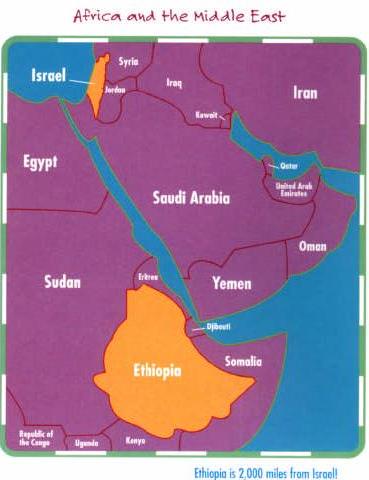
It is well known that many textbooks in use in the Middle East fail to show Israel on their maps, as for example in this map from a 4th grade Syrian civics textbook. Or Kashti reports in today's Ha'aretz that:

...on the Web site of the Israel Defense Forces intelligence division, in a section dubbed "the hatred industry," the site analyzes the textbooks distributed by the Palestinian Authority. The writers point out that the maps do not mention Israel's name. They complain that when the Green Line is marked, Israel and the territories are shown in the same color. That is one of the "sophisticated methods of bypassing the problem," the site says [link to the report that Kashti cites, by Dan Meridor].
What you may not know, however, is how the state of Israel is presented in maps in Israeli textbooks. In the same article, Kashti reports on a two-year old study by Dr. Nurit Peled-Elhanan of the Hebrew University's School of Education:
Peled-Elhanan examined six textbooks published after the Oslo Accords, including some that were officially sanctioned by the Education Ministry. Other books were adopted by many teachers even though they were not officially approved. Among the salient findings were the blurring of the Green Line, the ignoring of Arab towns in Israel, and the presentation of sites and settlements in "Judea and Samaria" (not the "West Bank") as an integral part of the State of Israel.

[editor's note: the map to the left is not, of course, from an Israeli textbook, but from YeshaHomestead, a site devoted to building settlements on land purchased from Arabs. If you should happen to be Haredi, rich, and willing to gamble on the future of settlements on the West Bank, you might be interested in purchasing a "big house" or a mansion in the mountaintop community of Givat Yakov. But I digress...].

This week, Minister of Education Yuli Tamir propsed that all maps in new editions of Israeli textbooks show the Green Line, and she wants the next budget to support private publishing companies in making the change. Akiva Eldar reports in Ha'aretz:

Tamir said Israel could not demand of its Arab neighbors to mark the June 4, 1967 borders, while the Israeli education system erased them from its textbooks and from children's awareness. "This is not a political issue, but rather an educational one," Tamir said Tuesday. "We teach, for instance, about United Nations Resolution 242, but we don't show students the Green Line. We cannot deny that there used to be a border that is still being debated today." Tamir defended the decision as the only way to teach students the basis of the region's politics.

Meanwhile, an organization of right-wing rabbis on Tuesday issued a Halakhic decree forbidding students from using schoolbooks featuring maps of Israel which include the pre-1967 Green Line border, Israel Radio reported.

Tamir's decision may indeed be partially political, but Or Kashti reports in another article that there is a pedagogic basis for the change: An improvement in the teaching of geography in Israel:

Education Ministry officials in charge of the subject are convinced the only way to make geography relevant and strengthen the subject's standing is to add current issues to the lessons - for instance, by marking the Green Line in school textbooks and on maps.

A new curriculum for 10-12th graders, which addresses the Green Line much more extensively, is set to be introduced in the next school year. In the new curriculum, students will discuss "the factors in the delineation of Israel's borders," including the 1967 Six-Day War, as well as "different approaches for delineating final borders."

The curriculum will present three primary approaches: a return to the 1967 boundaries, preservation of "Greater Israel" and various proposals for border adjustments and compromise. The students will be expected to recognize and understand the "different approaches for defining the borders of the Land of Israel and the State of Israel."

"The question of borders will become an issue that is debated in the classroom," said [Education Ministry's supervisor-coordinator for geography studies, Dalia] Panig. "The education system should not bury its head in the sand. There is a constant debate in Israeli society regarding the different approaches to determining the borders, and there is no reason it shouldn't take place in the classroom. It is unacceptable that a student should hear terms like 'the Green Line' and not recognize them.

As in Israel, many of the maps and textbooks that are in wide use in liberal Jewish settings in the United States don't demarcate the West Bank, Gaza Strip, or Golan Heights in any way. For example, take a look at this map from Behrman House's 4th-6th grade textbook "Welcome to Israel".

The chapter from which the map is taken addresses the diverse population of the State of Israel. It notes that Israel is home to one million Arabs and to a variety of religions that consider it a holy land. It asks readers to ponder questions of the nature of a "Jewish state," such as whether non-Jews should be able to hold Israeli citizenship and whether the prime minister should be a rabbi. It even includes a photo of Rana Raslan, the first Arab Israeli to be crowned Miss Israel [a kindergarten teacher, incidentally], and quotes her as saying "...it does not matter if I am Jewish or Arab, I will represent Israel as best I can." In short, the chapter does a fine job of depicting the pluralistic nature of the State of Israel and the questions such diversity raises. Yet, in the map accompanying the chapter, it is clearly "greater Israel" that is shown.

How does your school or educational program handle the question of maps of Israel? Do the textbooks you use or the maps you hang on the wall show the Green Line? Do you "problematize" the question of borders, as the Israeli Education Ministry now intends to do with its High School students? If you aren't clear on the answers to these questions - may I suggest that this is a good opportunity to take a second look at your materials, and to enter the same debate that Yuli Tamir has raised here in Israel.

Monday, December 04, 2006

Simon Maccabee: A Chanukah Story

My friends,

As Chanukah approaches, I'd like to share with you an original story that I wrote two years ago while Director of Education at Central Synagogue. I told this story at Friday night services as a lead in to the students in the 4th and 5th grades singing Debbie Friedman's "Not By Might." It is the story of Simon Maccabee, a lesser-known Maccabee sibling. Here is an excerpt:
I think most of us here know about Judah Maccabee . . . but not so many people have heard about his brother, Simon Maccabee. We don’t know a whole lot about him, but I think I remember hearing somewhere that Simon was a 4th or 5th grade teacher.

Simon wasn’t a great fighter, but he loved to cook. Each morning he would fry up some mighty tasty latkes. When his brothers would come home in the evening, they always had new people with them who had decided to join in the fight against the Syrians

. . . Soon, Simon was getting up earlier and earlier to peel the potatoes and fry up the onions, and long lines of soldiers would wait for the mighty tasty latkes. Simon started to arrive later for work and his students would all wait impatiently for him to begin his lessons.
The entire text is after the jump. Please feel free to pass it along and to retell it in your own words.

Happy Chanukah!