(Full transcript after the jump)
Showing posts with label home. Show all posts
Showing posts with label home. Show all posts
Friday, May 24, 2019
The Story about the Baby Sharks
I told a story about the ritual of counting the omer at Shabbat Services for Temple Emanu-El. It is based on a famous one about starfish that I learned as a kid in CRaFTY (the NYC region of NFTY, the Reform Jewish youth movement).
(Full transcript after the jump)
(Full transcript after the jump)


Wednesday, October 24, 2018
Talking with our children about tragic events
This is what I shared with the Religious School community at Temple Emanu-El after the events at Tree of Life Synagogue:
Dear School Families,During Religious School on Sunday and Monday, we did not explicitly raise the tragic events at Tree of Life Synagogue in Pittsburgh with our students. We know that every child is different, and each family must choose to handle the situation in its own way. Yet, we also know that many of our children have questions and fears that we, as their parents, want to address – not to mention our own, adult concerns.I want to share with you the guidance I gave our faculty, which holds for parents as well:
- If the children bring up the topic, don’t shut it down. Listen attentively to what they have to say -- their concerns and their questions, their thoughts and feelings -- and let that drive the conversation.
- Try to answer questions factually without adding unnecessary details. Don’t assume that your questions and concerns are theirs.
- Reassure the children that Temple Emanu-El is a safe place; we are a sanctuary for all people seeking comfort and support. Here at Emanu-El, there are many adults who are looking out for them and who know exactly what to do to prevent emergencies of all types from happening. A good example is that when there is a fire drill, we all are trained to respond quickly and safely. There are other things that the kids don’t know about that we, the adults, are doing to keep them safe.
- Let them know that an important part of what it means to be Jewish is that when we hear about tragedy, we want to respond. That is why Emanu-El is participating in city-wide vigils (both to express our emotions and to demonstrate our solidarity) and why our Philanthropic Committee and Student Council are already talking about what we can do to help the people of the Tree of Life Community.
- Remind them that there are always many more people trying to be good than to do harm, of all religions, backgrounds, and nationalities. Unfortunately, it is so much easier to be destructive than to build, and bad news always gets the headlines – but remember, although there are some dangerous people in the world, nearly everyone you meet is a kind, generous, loving person like yourself.
Thursday, March 01, 2018
The Golden Age of Religious School Education
I wrote this article for the March-April 2018 edition of the Temple Emanu-El Bulletin.
The challenges of Jewish education are largely the same as they were more than a century ago, when the first generations of American Jews began attending supplementary schools. Forced by these challenges to be inventive and resourceful, the best educators integrated innovative approaches and cutting-edge practices. And yet, because we are in an era of unprecedented collaboration, I believe we are now in a “Golden Age” for religious schools.
Tuesday, September 23, 2014
Why do we bless our bread? (Part IV)
Tomorrow evening we enter into the sabbatical or shmita year, and so once again I share with you a section from my master's thesis on Birkat Ha-Mazon, the grace after meals. In my three previous posts, I discussed the significance of sanctifying the act of eating, how saying this blessings can help us think about proper nutrition and a healthy diet, and how we should always relate to our food as a Divine gift.
This week, as is only fitting in the days after the world's largest climate-change protest here in NYC, I discuss how saying this blessings can help us to confront our increased alienation from the sources of our food. The thesis in its entirety can be found online at the Lookstein Center for Jewish Education.
This week, as is only fitting in the days after the world's largest climate-change protest here in NYC, I discuss how saying this blessings can help us to confront our increased alienation from the sources of our food. The thesis in its entirety can be found online at the Lookstein Center for Jewish Education.
Birkat Ha-Mazon is an opportunity to examine where our food comes from, how it is grown and raised, how it is packaged and transported to us, and how it is prepared. In the modern era, most city-dwellers have lost touch with the sources of origin of their food. This is evident in the description of the world in Goldberger’s How to Thank HaShem for Food: “The earth is the most ancient and the most modern food-factory which was created and is constantly maintained by the Master of the Universe” (p. 21). We have become so alienated from the processes of farming and harvesting that in order to provide an analogy that makes sense to the contemporary reader, Goldberger describes the workings of the world in terms of a factory, the strongest symbol of industrialization and the human domination of the planet one could find!References
Arthur Waskow analyzes the problem, asking whether “in our own time of earthquake both in the world and for the Jewish people . . . we need to rethink how to make food sacred as deeply as our ancestors did? For them, food was no longer what they grew in a small land by dint of their own labors, but what came to them by ship and camel train. For us, food has more and more become what is manufactured, not just grown: It comes from crossbred and genetically engineered plants and animals; it comes with inserted vitamins; it comes heavily packaged, precooked, frozen, irradiated, invented” (p. 68). Dr. Steven M. Brown asserts the value that Birkat Ha-Mazon can have in responding to this situation, for each time we say a blessing we acknowledge God and the chain of events (human or otherwise) that enabled us to have the gift of food in front of us.
Even when the Israelites experienced the miracle of manna falling from the sky, they still were obligated to collect it every morning, for it would rot if kept overnight (Exodus 16:21). The lesson here seems to be that our sustenance is the result of a partnership between God and human beings. Food is a miracle, but human effort plays a critical role in planting, raising, harvesting, and preparing the food we eat. Ultimately, God is the source of all of our nourishment, but we must also be aware of the humans (such as the farmers, the truckers, and the cooks) which brought the food to our mouths.
Goldberger, Moshe. How to thank Hashem for Food: Lessons from Birkas Ha-Mazon. New York: Gross Books, 1988.
Waskow, Arthur. Down-to-Earth Judaism: Food, Money, Sex, and the Rest of Life. New York: William Morrow and Company, 1995.
Tuesday, September 16, 2014
Why do we bless our bread? (Part III)
Before I share with you this third gleaning from my master's thesis, I want to mention that my brilliant (and pedantic) friend Ori correctly observes that the title of this series is poorly worded, as we do not actually bless our bread. Rather, when we say a blessing we are blessing God, or rather, we are blessing God's ineffable name.
This is, of course, a critical difference. If you arrive late to Shabbat dinner, you are still required to make the blessings over the challah before you start eating. This is because, when we say a blessing over food, the food itself is in no way changed. What was previously an ordinary piece of bread is not made sacred (as is, for example, believed by many Christians to be the case for the communion wafer). Rather, it is our relationship to our food that is altered and made sacred, as is described in more detail in this excerpt. My thesis in its entirety can be found online at the Lookstein Center for Jewish Education. The full text of this section is after the jump.
This is, of course, a critical difference. If you arrive late to Shabbat dinner, you are still required to make the blessings over the challah before you start eating. This is because, when we say a blessing over food, the food itself is in no way changed. What was previously an ordinary piece of bread is not made sacred (as is, for example, believed by many Christians to be the case for the communion wafer). Rather, it is our relationship to our food that is altered and made sacred, as is described in more detail in this excerpt. My thesis in its entirety can be found online at the Lookstein Center for Jewish Education. The full text of this section is after the jump.
According to tradition, Birkat Ha-Mazon was instituted by Moses at the time when the manna miraculously descended to feed the Israelites during their travels in the Sinai desert (Talmud Berachot 48b). Elie Munk, quoting S. R. Hirsch, writes that by connecting Birkat Ha-Mazon to the manna, the rabbis teach us that “every piece of bread eaten now is as much a gift from God as the manna was.” (1954, p. 211). Goldberger, drawing from Talmud Pesachim 118a, asserts that the process by which God “causes a seed to transform earth into food [is] as spectacular as the miracle of the splitting of the sea” (1988, p. 5).
The point of each of these statements is that food is always gift from God, a gift which cannot be taken for granted. The provision of food is a daily miracle, whether it is effortlessly picked from the trees (as in the Garden of Eden) or reaped from the earth through great effort (after leaving the Garden). “The message appears rather clear: When we thank God for giving us food, we are recognizing that there is no intrinsic difference between the manna and the livelihood one wrests from the earth through sweat and hard toil; both are gifts from heaven” (1984, p. 182).
This connection is also made in the blessing said prior to eating bread, “Ha-Motzi.” This blessing thanks God “who brings forth bread from the land.” Bread – not wheat, which would be more technically accurate – to affirm God’s centrality to the entire process of making bread, from the sprouting of the grain to its baking in the oven. As Evelyn Garfiel puts it, “finding his daily bread never ceases to be a Nes [miracle] even to the farmer who toils so hard to produce the grain, for he recognizes its ultimate source to be God’s loving care for all His [sic] creatures. It is God ‘Who brings forth [the] bread from the earth’” (1958, p. 122).
Thursday, August 21, 2014
Why do we bless our bread? (Part II)
Continuing to mine my master's thesis on Birkat Ha-Mazon, the grace after meals, as we build up to the shmita year, this week I share with you the section on using the prayer as an opportunity to focus on proper nutrition. I won't overstate the analogy, but I believe that just as saying this prayer can be a time for personal and communal reflection on issues relating to food, diet and nutrition, so too can we look at the coming year as a chance to rethink and renew our approaches to these topics. The thesis in its entirety can be found online at the Lookstein Center for Jewish Education. The full text of this section is after the jump.
The World Health Organization defines "Health" as balance between physical, mental and social being. Birkat Ha-Mazon reminds us of the need to pay attention to, and strike a balance between, each one of these aspects of our health. Birkat Ha-Mazon is a social activity, as it is often said as the conclusion of a communal meal. Focusing on the text can lead to heightened cognitive awareness of, and encounter with, challenging issues affecting Jews and people in general. Here, I wish to look at the role that Birkat Ha-Mazon can play as a focal point in thinking about the physical impact of food on our bodies, or in other words, for nutrition education.
According to Genesis 1:26, humans are created “b’tzelem Elohim,” in the image of God. Although the interpretations of this are manifold, one generally accepted implication is that any form of self-harm violates Jewish law as it is a desecration of the Divine image. The extent to which this principle is applied varies: Some communities forbid body-piercing based on this idea, while others will not smoke cigarettes. Arguably, a concern for proper diet and exercise should be considered a Jewish obligation.
Birkat Ha-Mazon is a mandatory pause at the conclusion of a meal. We can use this time to make a connection between the food we have eaten and the nourishment it has provided us. This is also an opportunity for us to reflect upon the choices we have made with the foods we have eaten. One might ask oneself questions along the lines of: Did I waste food? Did I overeat? Was the food grown (or raised) in a manner that fits with my ethics? How did this food get from its point of origin to me? How did the choices I made affect other people’s lives?
Thursday, August 07, 2014
Why do we bless our bread?
As some of you will recall, my master's thesis as a student at Davidson School of Education (15 years ago!) was on Birkat Ha-Mazon, the grace after meals. As we round the corner into a shmita year, I thought I'd take this opportunity to share with you a section of that work. The thesis in its entirety can be found online at the Lookstein Center for Jewish Education. The full text of this section be found after the jump.
A concern for food appears at the very beginning of the Bible. Sustenance for human beings, and for all creatures, is viewed as an intrinsic component of the Divine plan of creation. In God’s first address to humanity, in the first chapter of Genesis, God instructs the humans that they may eat from every plant on the ground and every fruit of the tree (Gen. 1:29). Shortly thereafter, this is qualified with the prohibition against eating from the tree of knowledge of good and evil (Gen. 2:17). Just as babies receive nourishment while in the womb, in the “perfect” paradise of the Garden of Eden, food is provided for humans without any effort on their part.
When the humans are expelled from Eden, a new stage in their relationship with food begins. Now, God admonishes Adam, only “by the sweat of your brow shall you get bread to eat” (Gen. 3:19). This is the first mention of bread in the Bible, which, in contrast to the fruit of the Garden of Eden, requires human labor. In the next chapter, perhaps in response to the anxiety provoked by the responsibility of providing food for oneself, Cain and Abel bring the first sacrificial offerings to God (Gen. 4:3-4). This offering can be seen as a petition, or as a thanksgiving, for successful harvests and healthy livestock.
Arthur Waskow writes of two ways by which the ancient Israelites sanctified the food they ate, which can be traced back to these first four chapters of Genesis. “One major approach they took to hallowing food was to set some aside as sacred, others as forbidden” (23). The prohibition against eating from the tree of knowledge can be seen as paradigmatic of this approach, later reflected in laws of Kashrut, tithing, fasts, Sabbatical years, and so on. The “other process for hallowing food was to take the products of the land to a single place, the Temple in Jerusalem, there to bring God near to them” (24). The offerings of Cain and Abel are the prototype for sacrificial worship, evinced in stories of Noah (Gen. 8:20), Abraham (Gen. 12:7) and so on, and which ultimately reaches its peak in the unified system of regulated sacrifices at the Temple in Jerusalem.
These two dimensions for the sanctification of food -- that of making distinctions between food which may and may not be eaten and that of consecrating food as an offering to God -- will be discussed in great detail in the upcoming sections. Here, I wish to emphasize that there is a third conception of the sanctification of food. The very act of eating, the turning of physical matter into energy, of the life-force in a plant or animal into one’s own life-force, is in itself a sacred activity.
Monday, March 29, 2010
An Ironic, Post-Modern Passover Anecdote
Since junior year of college - that's more than 20 years ago - I've been celebrating the second seder with friends. Most of us hated our parents' seders - rushed, boring Maxwell House eat-fests - and we wanted something a little more meaningful for ourselves.
For the first ten years, there was only one rule: No parents invited - and then we had to do away with that rule too, as we started becoming parents ourselves. So now there are no rules.
The seder is run as a pot-luck: Everyone brings a dish, a bottle of wine, and contributes some cash towards rental of tables and chairs and such. The amount of text from the haggadah that gets read has declined dramatically as the number of kids at (or near) the table has surpassed the number of adults - although as the median age of our children climbs, I'm sure they'll take a more active role in shaping the evening.
For many years, the seder would be held at whoever's apartment was the biggest - for the past few years, we've been consistently in the same Park Slope brownstone. This year, however, at the last minute (the night before Erev Pesach), we had to suddenly find a new location.
This turned out to be a challenge: Most of our apartments can't accommodate around twenty adults and an equal number of kids, many under the age of two. One couple was traveling back from another country that afternoon, another had just moved into a new apartment and hadn't unpacked, a third was hosting the first seder and then working all day on Pesach, a fourth lived in - gasp - New Jersey.
But here was the most amusing complication: You see, most of us who come to this seder don't keep a kosher kitchen (especially those of us who aren't Jewish). So one couple couldn't host because they had kashered their apartment for Passover. In other words, because their place had been made ready for Pesach, it was no longer possible to have a seder there. If you ask me, that's the irony of post-modern Jewish life.
Don't worry - that friend's mom has come to the rescue, and we're hosting it at her place - if she comes, she'll be the first grandparent we've had at the seder.
Chag Kasher v'Sameach!
Thursday, November 06, 2008
Get Paid to be Jewish? Part 2
Do you remember way back when, when I blogged about Moishe House, with a quote from the JTA:
"Say you’re a few years out of college, living with friends and working in a low-paying job for some do-good organization. You don’t go to synagogue but you miss the camaraderie of your college Hillel, and you like to invite people over for Shabbat meals.
"Imagine if someone was willing to pay you to keep doing it?"
Well, Ben Murane has thrown down on birthright NEXT's similar initiative on Hazon's Jews-n-food blog "The Jew and the Carrot," under the heading "Do We Need to Pay Birthright Alumni to Have Shabbat Dinner?"
"Once again, the organized Jewish community has decided to answer the droopy quality of Jewish life offerings with a marketing campaign and financial largess. I think NEXT’s money is mispent."
Now, what makes this such a tremendously worthy read is that the very first response to Ben's post is from none other than Birthright Israel NEXT Executive Director (and fellow blogger) Daniel Brenner:
" . . . we are proud that through small grants that we have been able to encourage over 600 people across the country to host meals in their homes. For a majority, it has been the first time in their life that they hosted a Shabbat meal. So far, 74.6% of those meals have been homecooked by many hands. Most people had 14 guests! We sponsored many vegan shabbats, raw food shabbats, organic shabbats, you name it. And good food is often not cheap — and not everyone has the luxury of being near a farmer’s market. And not everyone has the time or skill to cook!
"Could we do it for $15 per person? maybe so. But we felt that $25 per person would make for a special meal.
"By the way, we are also providing financial assistance for Birthright Israel alumni to attend the upcoming Hazon Food Conference. We do so because we have found that in these economic times, people in their twenties do not have alot of spare change to go to Jewish confereces."
But wait! Who is the next comment from?
"Don’t worry, Rabbi Brenner. I’m hosting plenty of birthright NEXT shabbat dinners at the apartment I share with Mr. Murane . . .Read the whole fun debate, and then get yourself some excellent baby swag, at The Jew and the Carrot.
". . . The money isn’t an incentive for me to host a dinner. It’s an *enabler*. Big difference."
Tuesday, January 08, 2008
Visit Israel without leaving your chair!
Thanks to Caren Levine, this press release is x-posted from jlearn2.0. You can read a little more about it, and see some photos, in the most recent issue of 2life magazine (December 2007 - The Hanukah Issue).
I'm having trouble keeping up with my first life, but perhaps you'll find me trying to find my way around as Think Witherspoon this Sunday in Second Life.
* * * * * * * *
This January, join us in Israel for an exceptional launch party.
SL Israel, the first complete virtual Israel, to launch January 13th in Second Life
In one of Second Life’s newest developments, its residents are now just a click away from being able to teleport into and experience the entire length and breadth of Israel.
This event in Second Life, an internet based 3-d virtual world with more than 11 million residents, marks the first time that a Second Life island will be dedicated in its entirety towards Israel.
To celebrate its inauguration SL Israel will have two parties on January 13th at 10 AM and at 7 PM PST [Note from Saul: That's this coming Sunday at 1 PM and 10 PM EST. Presumably we can expect more Israelis will be at the one in the afternoon].
Israel is a country that is at once very dynamic yet rooted in its history. SL Israel reflects these qualities as well. It features on the one hand the holy sites of all three major monotheistic religions, including the Western Wall, the Church of the Holy Sepulcher, and the Dome of the Rock.
At the same time, as a very modern and colorful country, SL Israel made sure to include such sites as the Tel Aviv promenade and Opera House, the Eilat underwater observatory, and the Machane Yehuda outdoor market.
The purpose of SL Israel is to present a complete and comprehensive Israel experience, both for the experienced sightseer and for the first time visitor. It aims to convey a variety of experiences about what Israel is all about, and to present the country in its complexity and diversity. SL has many residents who come from Israel, Jews from all over the world, and people from all over the globe who are interested or curious to learn more about Israel.
SL Israel offers them alike the opportunity to meet one another, to learn about each other’s heritage, and together to travel around a country that is both ancient and very modern.
For additional information:
Contact in SL; Hagibor Shepherd or Beth Odets
E- Mail: SLisrael8@gmail.com
Who we are: SL Israel is the initiative of Chaim Landau, assisted by Beth Brown.
Chaim (SL Israel founder) recently completed a Legacy Heritage Fellowship at the European Union of Jewish Students and currently studied at the Pardes Institute.
Beth (SL Israel Building/ Design manager), built the first Synagogue in SL, in 2006, which has grown into a full Jewish neighborhood in SL .
Wednesday, December 05, 2007
Supplementary Jewish Education: The State of the Art
 The Autumn 2007 issue of Contact, the journal of the Steinhardt Foundation for Jewish Life just came out, and the topic is "Supplementary Jewish Education: What Can Be Done?"
Editor Eli Valley writes in his opening piece:
"... for the majority of American Jews, afternoon schools are and will continue to be the preferred venue of Jewish education. Instead of declaring the demise of Hebrew schools, the community should recommit itself to making afternoon schools work ... afternoon schools can take the initiative in creating innovative, dynamic and rewarding Jewish educational experiences ... that can help form the cornerstone of a revivified Jewish life."
Steinhardt's own contribution advocates for moving supplementary school out of synagogues and away from a curriculum oriented toward bar/bat mitzvah, in favor of home-based learning in small groups. The issue features several profiles of schools by their directors, including the Kesher after-school Hebrew programs in Cambridge and Newton, Tribeca Hebrew in New York City, and Prozdor High School in Boston. There are also more topical pieces on the role of community and vision in making Bar/Bat Mitzvah and family education meaningful.
Other articles include an overview by Nathan Laufer of the work being done by his organization, PELIE, to disseminate both the Kesher model and the model of the NESS program from Philadelphia's Auerbach agency, an explanation of the principles behind the Chai and Mitkadem curricula from the Reform Movement by Rabbis Jan Katzew and Daniel Freedlander, and one by yours truly on the full-time teacher model at Central Synagogue in New York. This is, to my knowledge, the first time that a description of this initiative has appeared on the web. I conclude:
"...It seems self-evident that having more qualified and better compensated teachers working longer hours with more responsibilities outside the classroom will improve a religious school program. The real value of such a shift, however, is the opportunity it provides to align the school’s curriculum, prayer experiences, and social justice activities with the vision and values of the synagogue as a whole. The integration of the religious school faculty into the daily life of the synagogue and the lives of its families provides new potential for building communities of learning and engaged Jewish living. True institutional transformation will come not only from improved pedagogy, but also from the creation of meaningful communal experiences outside the classroom."
The final word in the issue goes to Bill Robinson, who just two weeks ago became Chief Planning and Knowledge Officer for the BJE of NY. In a turn of phrase reminiscent of Douglas Rushkoff, he writes:
" ...in Authentic Jewish Education we will recognize and honor those who have wrestled with Judaism before us. We will also metaphorically kill Judaism every day by taking it apart, turning it upside down and pulling it inside out — constantly creating the new while remembering the past."
Of course, no issue could cover everything - for me, the conspicuous absence is anything relating to technology - but this issue certainly provides one of the most accessible overviews of new trends in supplementary education currently available. Enjoy!
Monday, June 11, 2007
Some thoughts on Family Education
In my opinion, family education is not simply about bringing the parents in to learn side-by-side with their children: It is about rethinking the relationship between the institution and the home.
For our learners, the home – not the school, synagogue, or summer camp – is the principal arena for the construction of personal meaning. In The Jew Within, Cohen and Eisen wrote that the immediate family exerts the greatest influence on Jewish observance, and parents are the primary agents of their children’s Jewish development. By the choices they make and the kinds of rituals that they incorporate into their homes, they model for their children what is meaningful and significant in Judaism.
Yet, this influence flows in both directions: Parents and children mutually reinforce each other’s Jewish observances and beliefs. In Linking the Silos: How to Accelerate the Momentum in Jewish Education Today, Historian Jack Wertheimer (the Joseph and Martha Mendelson Professor of American Jewish History at JTS) observed that parents can be “spurred on to further their own Jewish education and upgrade their own Jewish knowledge” and to introduce Jewish rituals into their lives as a result of their child’s Jewish involvement. For this reason, Jo Kay, Director of the New York School of Education of Hebrew Union College, suggests that we should look at the individual and the family as an inseparable unit: “Looking at the learner through the lens of the family impacts our perception of who we are teaching. The learner is no longer an individual without a context, but rather a member of a family and the family is ultimately the “student” we are trying to reach” (in her article “Family Education” in the Ultimate Jewish Teachers Handbook).
Our education programs, therefore, must be designed to have clear tie-ins to home observance and family life, providing resources that enable our participants to engage in the content they are learning. For example, giving them the opportunity to explore how they might make their own Passover seders more meaningful or relevant (or hold one in the first place), provides them with the chance to directly impact on their family’s practice.
By the same token, we must provide volunteer opportunities for parents not simply to hand out Chanukah candles and serve latkes, but to play a critical role in setting the agenda for our family education programs. For example, parents ought to be represented in decisions about whether a Religious School’s Hebrew curriculum will place greater emphasis on learning to speak contemporary Israeli Hebrew or on acquiring the skills to participate in a prayer service.
In this way, parents will be empowered to take responsibility for the Jewish upbringing of their own children, students will be empowered to take part in shaping the Jewish life of their families, and the educational program will be a partner in the process rather than the provider of Jewish identity.
Monday, May 28, 2007
Cory says, "Homework Sucks!"
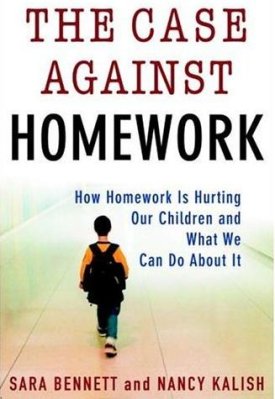
"...all the credible research on homework suggests that for younger kids, homework has no connection with positive learning outcomes, and for older kids, the benefits of homework level off sharply after the first couple assignments...
"...Not that most teachers would know this -- homework theory and design isn't on the curriculum at most teachers' colleges, and most teachers surveyed report that they have never received any training on designing and assessing homework...
"...The stories go on and on, and just when you're ready to throw in the towel and send your kids into the woods to be raised by wolves, the authors supply several long chapters of strategies and sample dialogs for convincing your kids' teachers to ease off on homework, for changing the homework policies in your school district and for rallying other parents to their cause.
"They're not whistling Dixie, either: the authors have gone through this themselves, challenging and changing the homework policies in their kids' school districts. The last section of the book is an activist guide and a postmortem of the strategies they employed. One of the authors, Sara Bennett, is a celebrated civil rights lawyer; the other, Nancy Kalish, is a famous editor and writer of material for parents, especially mothers. One imagines that their school board didn't know what hit them" [full text of review].
More information can be found on StopHomework.com, co-author Sara Bennett's blog. She recommends taking action by signing the petition calling for the dismantling of the "No Child Left Behind" Act at The Educator Roundtable.
Saturday, May 26, 2007
Sure Mark . . . why not? (Survey on "Family Purity")
I received this email earlier today, which I am quoting in full:
"My name is Mark Guterman. I am a Clinical Psychology PhD student working with Orit Avishai of the University of California at Berkeley. We are doing an internet survey of Jews of all denominations. The survey is for both singles and married couples. The survey is online at: http://www.JewishSurveys.org.
"I was wondering if you could post a link on your site for our research? I ask you, because your blog draws readers of a type that we may not be able to reach through any other means. Please help us out. We are not making any money on this; we are simply trying to learn more about our community. Your cooperation in this would be greatly appreciated, and you would be doing a service to the Jewish community at large.
"More info on the survey: The study looks at issues regarding Negiah (premarital touching) and Niddah / Taharat HaMishpachah (family purity). Niddah and Negiah play an important role in the every day lives of Jewish men and women. The collection of handbooks on this topic grows from year to year, yet we know very little about how Jewish couples, men, and women experience and observe Niddah and Negiah. Anecdotal evidence and our previous research have led us to conclude that many couples and individuals are experiencing difficulties with this aspect of the Halachah.
"We are inviting the Jewish community at large to participate in this important survey to shed light on these difficulties and explore some ways to address them. Given the intimate nature of these matters, this brief, online survey is totally anonymous, and no identifiable information is collected."
Follow this link to take the survey. You must be 18 years or older to participate, and all information is provided anonymously. I took the survey (it takes about 10 minutes): You may find that your responses do not easily correspond to the choices provided in the drop-down menus. However, I was amused to see that kashrut and shabbat observance is rated on a scale from "flexible" to "strict."
Tuesday, May 15, 2007
Sesame Street returns to Israeli and Palestinian television
Off the air (due to a lack of funding) since 1997, "Rehov Sumsum" returned to the Israeli children's cable television network "Hop!" this past Chanukah (2006). This week, Ma'an, an independent network of Palestinian television stations will begin broadcasting their version of the series. Ha'aretz reports:
"...Producers tailored the Middle Eastern casts and story lines to the fit the audiences. 'Rehov Sumsum,' the Israeli version of the show, for the first time includes a Muppet of Arab origin. Its Palestinian counterpart, 'Shara'a Simsim,' seeks to offer positive role models to boys in the West Bank and Gaza Strip." (April 30, 2007)
A little background:
"...After the shows ended in 1997, a joint Palestinian-Israeli production in the planning stages was shelved when the Palestinians launched the second intifada in 2000.
"Instead, a limited series called 'Sesame Stories' was produced in 2004 by independent Israeli, Palestinian and Jordanian production teams. The animations and live-action episodes were dubbed and aired on each other's series.
'The Muppets couldn't speak each other's languages, but they connected over falafel and hummus, and a common dislike of onions,' Knell said."The new Israeli and Palestinian shows are produced independently, placing an emphasis on educating children about their own societies. Like any "Sesame Street," they also teach basic skills like numbers and letters, good manners and keeping the environment clean.
"'Rechov Sumsum' teaches tolerance by portraying a street inhabited by Israelis of varying backgrounds who live together peacefully: Jews and Arabs, religious and secular, veterans and immigrants. The neighbors are real-life children and adult characters, including a Jewish man named Tzahi, an Arab woman named Ibtisam, a Russian woman named Irina and an Ethiopian student named Malkamo." (JTA, May 14, 2007)

Sesame Workshop, in a press release from last December, described the initiative as part of their commitment "to creating and providing positive media content for children in the Middle East." Along with the new Israeli and Palestinian versions, this includes productions in Egypt ('Alam Simsim', now entering its 10th year) and Jordan (Hikayat Simsim). The new Palestinian series:
"...will be accompanied by an educational outreach campaign, will feature a new set that now includes a Fix-It shop run by Salim, a new male character in his early 20’s. Beloved Palestinian Muppet characters Haneen, a 5-year-old learning how to count and read, and Kareem, a 7-year-old rooster, who is organized, tidy, timely, and traditional, return to Shara’a Simsim. The new season responds directly to the needs of Palestinian children by focusing on boys’ empowerment and introducing the character of Salim, who will serve as a positive role model for young children."
All this is great news for Israelis (and the rest of us) who until now have had to turn to YouTube to hear "Barvazoni" ("Rubber Duckie" sung in Hebrew).
Tuesday, April 03, 2007
Wicked Good?
What should we think of the wicked child, who challenges all of us gathered around the seder table at Passover with the question "What does this practice mean to you?"
First, you might not realize that the wicked child is quoting from the Bible - Exodus 12:26, to be precise. In its original context (at the very first Passover celebration on the eve of the Exodus from Egypt), the question is framed as the one that will be asked by future generations - and it receives a straightforward response, an explanation of the meaning of Passover.
The haggadah, however, sees the question in a less positive light (as is made obvious by labeling the child as "wicked"). It indicates that asking what Passover means to "you" signifies the wicked child's hostility to the community. We are instructed to set the child's "teeth on edge" and quote scripture back to the child: "It is because of what God did for ME when I went free from Egypt" (Exodus 13:8). Had you been there, wicked child, you would have been left behind in Egypt.
David Mamet, in his 2006 book The Wicked Son: Anti-Semitism, Self-Hatred, and the Jews (part of the fabulous NextBook series), begins with the premise that "the world hates the Jews" and so every Jew must choose sides: "In or out" (7). He writes that the "wickedness of the wicked son" is that he "would not stand with those who would stand with him:"
"He feels free to enjoy his intellectual heritage, the Jewish love of learning, and reverence for accomplishment; he enjoys, aware or not, a heritage of millenia of Jewish Law and values; he enjoys his very life, which would have been denied him and his ancestors in the Europe they suffered to leave; he enjoys the right to protection from the community he disavows and, through it all, parrots, 'My parents were Jews, but I do not consider myself a Jew'" (128-9).
In his book, Mamet seeks to issue a wake-up call to such Jews, telling all wicked children to cease blaming Jewish community for its shortcomings and to take pride in their heritage as the descendants "of kings and queens, a holy nation and a kingdom of priests" (180).
"...it is also hard to overcome reasons against maintaining a Jewish identity. The most powerful arguments for assimilation stem from the liberal Enlightenment vision of a universal common humanity. On this view all that is significantly human is, or ought to be, universal . . ." (3)
Silver takes a more positive view of the wicked child than Mamet, writing that "among contemporary Jews there are many wicked children, and they merit answers that amount to more than the traditional scornful dismissal" (1).
Silver's fascinating book attempts to provide a philosophical basis for a Jewish identity that doesn't compromise liberal or secular values. His premise is that "the wicked child's question has a certain logical and moral priority" over that of the wise child, who wants to know all the details for observing the seder. Once the wicked child is satisfied with a more general understanding of "what it is all about, the desire for details will follow. The transition from wickedness to wisdom, from estrangement to communion, is a natural one" (189).
I'd like to chart a middle-path between Mamet's decrying, and Silver's celebrating, of the Wicked Child's question. On the one hand, I think that the question itself is a legitimate one. After all, at the seder we are instructed to invite all who are hungry to join us, and the wicked child might be a guest who is a stranger and - who knows - maybe not Jewish? At least the wicked child is paying attention enough to ask a question!
Yet - even though the wicked child's question is confrontational, I'd rather have the child at the table - sitting uncomfortably and annoyed, perhaps - than for the child not to be there at all. I want to thank the wicked child for joining us for the seder, despite having those feelings of alienation and anger.
I would suggest - and here, I think the haggadah agrees with me - that all four children ought to be present at the table. We should be glad when the wise child doesn't go off to hold a seder composed entirely of other wise children, but is willing to suffer through the questions of the simple child (probably with much eye-rolling). The simple child, too, must find the meticulous questions of the wise child tedious, waiting impatiently through even more details of the laws of the afikomen.
Let us not be quick to dismiss the wicked child, any more than we ignore the silent child or become frustrated with the endless questions of the wise and simple children. All four voices - even the silent voice - need to be heard. I'd rather have the seder be a place where the wicked child's question can be asked than leave it go unspoken, with the wicked child sullenly refusing to participate but not explaining why.
Thursday, March 29, 2007
Don't forget to count the Homer!
If you're like me, every year you try to count the Omer and don't quite succeed (one year we actually forgot to count at the second seder itself!). Although I have one friend who remembers to count by using post-its on the bathroom mirror, most experts recommend the use of an "Omer calendar" placed in a visible place. 

Of course, others prefer to use The Homer Calendar to guide them through this period.
UPDATE: April 12, 2007: BZ (of Mah Rabu) has posted an on-line guide of individuals who are "blogging the omer" - marking each day of the omer with teachings or other commentary.
Monday, March 26, 2007
Five resources for Passover 5767

Although by no means a comprehensive list (or even necessarily the best of what's out there), here are a few gems that I've discovered over the past few days while researching the previous posts (in no particular order):
- Eliezer Segel's modern classic "Uncle Eli's Special-for-Kids Most Fun Ever Under-the-Table Passover Haggadah" is written in the style of Dr. Seuss and provides brief, straightforward explanations of all the seder rituals and Hebrew terms.
- Dr. Barry Dov Lerner's jewishfreeware.org has a hosts a variety of downloadable Passover texts, including a variety of haggadas, a songbook, and a handy guide to creating your own "heirloom family haggadah."
- The Jewish Agency for Israel hosts an astonishingly comprehensive variety of educational resources for Passover, and in five languages.
- Rabbi Mark Zimmerman at SiddurAudio.com provides (Ashkenazi style) audio clips for most of the prayers and songs of the seder.
- And finally, among the many Passover resources of the Distance Learning project of the Jewish Theological Seminary of America is Dr. Steve Brown's guide to leading a Passover seder based on his many years of experience leading model seders.

Happy Passover, everyone!
Seder Suggestion: An Empty Chair for Darfur
Rabbi David Levin-Kruss offers this idea (which has generated some controversy on the Lookjed discussion group):
Like many, I watch the events unfolding in Darfur and wonder what I can do to help.This year I have decided to use our Pesach seder as a way to further the cause and I suggest you do the same. Rather as in the days of the Soviet Jewry movement I propose that we leave a chair empty for those in Sudan and donate the cost of one meal to a charity working to alleviate and change the situation. We could also ask our guests to donate rather than to bring gifts.
In the Vehee She'amda prayer in the haggadah we read that in every generation others have stood against us to destroy us, but the blessed Holy One saved us. This is an appropriate point to say something along the following lines:
"In this prayer we read that we are and have been persecuted. Let's remember that we are not the only persecuted in the world and that others suffer too e.g. those in Darfur. Let us pledge today to act as G-d's mouth and hands by speaking truth to power and doing what we can (politically, militarily, financially, and personally) to bring about a better situation. Let us hope that next year we will not need to leave a chair open to mark those who do not share the freedom we have."

For more information about what is happening in Darfur and what you can do, check out these resources from Raising Awareness Destination: Darfur (RAD:D), founded by High School student Sarit Rosenstock and hosted by Areyvut. Organizations seeking funds for relief and advocacy efforts include American Jewish World Service (AJWS), the Jewish Coalition for Disaster Relief (JCDR), Jewish World Watch (JWW), and the Save Darfur Coalition.
This final organization makes it possible to take immediate action by sending an email to President Bush.

Monday, March 05, 2007
Job Posting: Family Learning Coordinator at Congregation Emanu-El of NYC
Please forward this posting to anyone you think might be interested:
Congregation Emanu-El of the City of New York
FAMILY LEARNING COORDINATOR
Congregation Emanu-El, the first Reform congregation in New York City, seeks to hire a part-time (20 hours / week) Family Learning Coordinator. This is a new position that is being created as an outcome of a year-long process of re-envisioning congregational learning.
The Family Learning Coordinator will be responsible for the planning and execution of formal and informal learning experiences for Nursery and Religious School-aged students and their families during and outside of school hours. Key responsibilities will include developing, directing, and evaluating holiday and Shabbat programming, field trips, and social action projects, and teaching both in and out of the classroom. Although this will be a largely programmatic role, the Coordinator will manage certain financial and administrative tasks (such as bookkeeping, registration, and publicity).
The Family Learning Coordinator will:
• Broaden and cultivate the target base served by formal and informal family programs
• Assess the interests of this population, and develop new educational, social, cultural, and religious initiatives
• Support the creation and execution of parallel learning opportunities for parents and home-learning experiences, including content delivered via email and the synagogue website
• Staff all family activities and events, including retreats and planning meetings
• Hire and supervise additional staff, volunteers, and chaperones as needed
• Develop adult leadership and build family participation.
• Evaluate and assess family programs and student achievement.
The ideal candidate:
• Brings new ideas and the ability to implement them
• Has both formal and informal educational experience
• Builds a pluralistic and Reform Jewish environment
• Has a strong understanding of family dynamics and child development
• Is familiar with Hebrew language and Reform Jewish liturgy
• Is committed to professional growth
• Is a team player, working collaboratively with clergy, other teachers, and parents
• Has excellent communication and organizational skills
• Is passionate, fun, enthusiastic, creative, and energetic
• Thinks big picture: How family activities fit into congregational living and learning
Candidates with a background in songleading, drama, and/or ropes-course are especially encouraged to apply. This is a challenging position that brings with it tremendous opportunity for achievement. We seek reflective practitioners who are committed to professional growth, are effective team-members, and who are able to share a love for learning and of Judaism with all members of our synagogue community. An advanced degree in Education and/or Judaic Studies is preferred.
The position requires evening and weekend work throughout the academic year. The ideal starting date will be July 10, 2007. This is a half-time (20 hours / week) position and salary is $25-30K based on experience. The Family Learning Coordinator will be supervised by the Director of Life-Long Learning.
To apply, please send a cover letter and resume to Saul Kaiserman at saulkaiserman@gmail.com.
Congregation Emanu-El of the City of New York
FAMILY LEARNING COORDINATOR
Congregation Emanu-El, the first Reform congregation in New York City, seeks to hire a part-time (20 hours / week) Family Learning Coordinator. This is a new position that is being created as an outcome of a year-long process of re-envisioning congregational learning.
The Family Learning Coordinator will be responsible for the planning and execution of formal and informal learning experiences for Nursery and Religious School-aged students and their families during and outside of school hours. Key responsibilities will include developing, directing, and evaluating holiday and Shabbat programming, field trips, and social action projects, and teaching both in and out of the classroom. Although this will be a largely programmatic role, the Coordinator will manage certain financial and administrative tasks (such as bookkeeping, registration, and publicity).
The Family Learning Coordinator will:
• Broaden and cultivate the target base served by formal and informal family programs
• Assess the interests of this population, and develop new educational, social, cultural, and religious initiatives
• Support the creation and execution of parallel learning opportunities for parents and home-learning experiences, including content delivered via email and the synagogue website
• Staff all family activities and events, including retreats and planning meetings
• Hire and supervise additional staff, volunteers, and chaperones as needed
• Develop adult leadership and build family participation.
• Evaluate and assess family programs and student achievement.
The ideal candidate:
• Brings new ideas and the ability to implement them
• Has both formal and informal educational experience
• Builds a pluralistic and Reform Jewish environment
• Has a strong understanding of family dynamics and child development
• Is familiar with Hebrew language and Reform Jewish liturgy
• Is committed to professional growth
• Is a team player, working collaboratively with clergy, other teachers, and parents
• Has excellent communication and organizational skills
• Is passionate, fun, enthusiastic, creative, and energetic
• Thinks big picture: How family activities fit into congregational living and learning
Candidates with a background in songleading, drama, and/or ropes-course are especially encouraged to apply. This is a challenging position that brings with it tremendous opportunity for achievement. We seek reflective practitioners who are committed to professional growth, are effective team-members, and who are able to share a love for learning and of Judaism with all members of our synagogue community. An advanced degree in Education and/or Judaic Studies is preferred.
The position requires evening and weekend work throughout the academic year. The ideal starting date will be July 10, 2007. This is a half-time (20 hours / week) position and salary is $25-30K based on experience. The Family Learning Coordinator will be supervised by the Director of Life-Long Learning.
To apply, please send a cover letter and resume to Saul Kaiserman at saulkaiserman@gmail.com.
Subscribe to:
Posts (Atom)